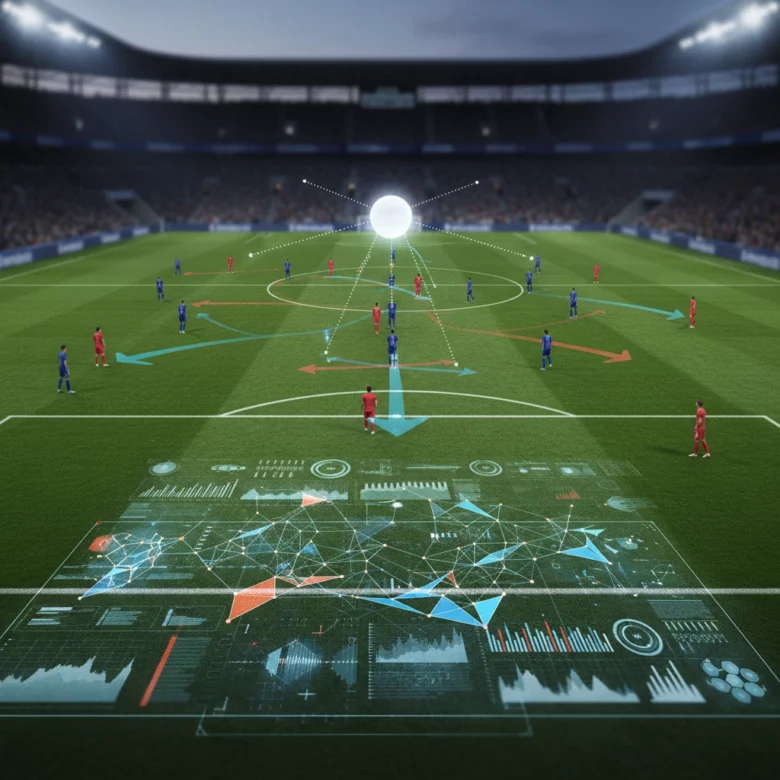
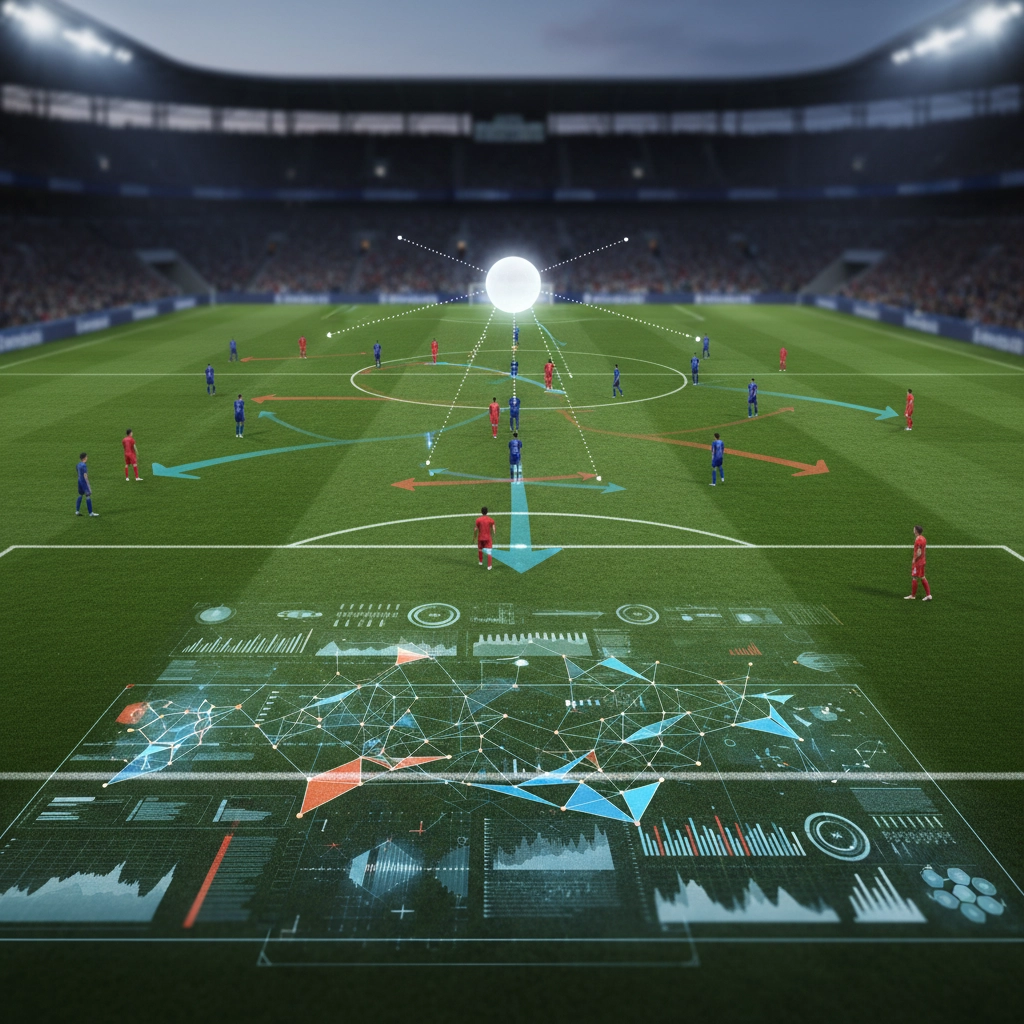
How off-the-ball movement creates goal-scoring opportunities and what you should notice
You already know that the player with the ball gets a lot of attention, but it’s the movement without the ball that often decides whether an attack becomes a goal. Off-the-ball movement covers runs, positioning, rotations and decoy actions that change defensive shape and open passing lanes. When you pay attention to these dynamics, you begin to see patterns that consistently lead to high-quality shots.
Start by observing the types of movement that tend to correlate with scoring chances: penetrating runs behind a high defensive line, late runs into the penalty area, and coordinated rotations that drag central defenders out of position. These actions alter space and create higher expected shot quality even when they don’t directly touch the ball. For predictive analysis, you should translate those qualitative observations into measurable signals.
Key movement metrics you can measure and monitor
- Line-breaking runs: frequency and success of runs behind the defensive line per 90 minutes.
- Late box entries: number of off-the-ball entries into the penalty area in the final third during build-up.
- Decoy effectiveness: how often a movement that doesn’t receive the ball creates a shot within X seconds or Y metres of the original action.
- Inter-player spacing: average separation that creates passing lanes and reduces defensive cover around the ball carrier.
- Trigger events: movement responses to specific cues (crosses, switches of play, winger dribbles) that lead to shots or high xG attempts.
By converting these behaviors into event counts, heatmaps, and conditional probabilities, you can build features for models that predict shot probability and expected goals (xG) more accurately than using ball events alone.
From movement signals to predictive indicators for goals and smarter betting choices
To turn off-the-ball insights into actionable predictions, combine tracking data (player coordinates at high frequency) with event data (passes, shots, dribbles). Use derived features such as the number of successful line-breaking runs in the last n possessions, or the probability of a late run resulting in a shot given team formation. These features feed into classifiers or regression models that estimate near-term goal probability and shot quality.
When you build or evaluate models, focus on robustness: validate on out-of-sample matches, test across different leagues and account for contextual factors like tempo and defensive pressing. As a bettor or tipster, look for consistent signals — teams that regularly generate high xT (expected threat) from off-the-ball actions or players with repeatable late-run behavior often outperform their raw shot counts.
- Data sources to explore: optical tracking providers, open tracking datasets, and event logs with positional tags.
- Simple markets to test with movement-driven signals: goals over/under, both teams to score, and player goal/shot markets.
- Modeling tips: include interaction features (e.g., run type × defensive line height) and normalize for possession share and opponent quality.
Next, you’ll learn specific analytics workflows, feature engineering recipes, and example model architectures to convert off-the-ball movement into concrete betting signals.

Practical analytics workflow: turning tracking streams into predictive features
Start with a clear pipeline that moves from raw coordinates to compact, interpretable features that capture off-the-ball intent. A sensible sequence is: ingestion → cleaning → event alignment → segmentation → feature extraction → labeling → storage. Key practical points:
– Cleaning and alignment: interpolate short GPS dropouts, synchronize tracking to event timestamps, and transform coordinates to a consistent pitch frame (account for camera/rotation). Remove unrealistic speeds or telemetry spikes before calculating movement vectors.
– Segmentation: slice the match into possessions or rolling windows (e.g., 10–30 seconds before an attacking outcome). Label each window by a target (goal within next n possessions, shot with xG > threshold, etc.). Use possession boundaries to avoid leakage across breaks.
– Feature recipes (examples you can compute quickly):
– Aggregate run features: count of line-breaking runs per window, mean run velocity into final third, and last-second acceleration toward the box.
– Spatial relations: minimum distance between attacker and nearest defender after a rotation, average lateral separation that opens passing lanes, and convex-hull area of attacking players.
– Temporal triggers: time since a switch of play, number of overlapping runs in last 5s, and defender displacement (meters moved away from central mark).
– Impact proxies: delta in team xT over the window, probability that a subsequent pass finds a late-runner, and expected shot quality conditional on movement type.
– Labeling: choose targets aligned with betting markets — e.g., probability of a shot in next possession, probability of a goal within 30 seconds, or the expected xG of the first shot after the window. Handle class imbalance with stratified sampling or by weighting losses.
– Storage and reproducibility: store feature vectors, window metadata (match, minute, scoreline), and version your extraction code so features can be regenerated for backtests and live scoring.
Model architectures, evaluation and deployment for betting signals
Pick models that match your feature form and operational constraints. For tabular, gradient-boosted trees (XGBoost/LightGBM) offer strong baselines and feature importance. Use logistic regression as an interpretable benchmark. For sequence-aware patterns, apply LSTM/Transformer encoders or temporal convolutional networks on time-series windows; for explicit player interactions, Graph Neural Networks that encode players as nodes with edges weighted by distance/pressure can capture coordination effects.
Evaluation must go beyond AUC. Use a combination of:
– Discrimination metrics: AUC, precision-recall for rare events.
– Calibration metrics: Brier score and calibration plots (critical when converting probabilities to stakes).
– Business metrics: simulated ROI and profit over historical odds. Backtest using out-of-sample chronological folds (never mix future matches into training), and test across leagues and game states.
Calibration and thresholding: apply Platt scaling or isotonic regression to adjust model probabilities to market reality. Convert calibrated probabilities into implied fair odds and compare against bookmaker odds to identify edges. Implement a staking rule (fixed fraction, Kelly, or utility-based) and simulate bankroll trajectories to estimate variance and drawdown.
Operational considerations: for in-play markets, prioritize low-latency feature computation (simpler, incremental features) and fast models; for prematch tips you can afford heavier models and cross-league ensembles. Retrain periodically to capture tactical shifts, and monitor model decay with live A/B or shadow betting experiments so your betting decisions remain grounded in robust, evaluated signals.

Putting off-the-ball analytics into practice
Move from prototypes to production through short, focused experiments: choose one or two movement features (for example, late box entries and line-breaking runs), instrument a simple scoring pipeline, and backtest against chronological holdouts. Prioritize features that are cheap to compute in live settings for in-play use, and richer spatial features for prematch ensembles. Keep a living checklist for data quality, model calibration, and market simulation so a small, repeatable experiment becomes a reliable signal or a discarded hypothesis.
- Start small: implement a single model (logistic or LightGBM) with a handful of robust features and evaluate calibration before scaling.
- Balance complexity and latency: reserve GNNs or Transformers for offline prematch models; use tree-based or logistic models for live betting.
- Governance: version features, track model decay across competitions, and log betting simulations (odds, stakes, P&L) to detect invisible biases.
- Learn from community resources and documented datasets as you iterate — for example, check out StatsBomb for practical articles and datasets.
Ethics and legality matter: respect data licenses, avoid redistributing proprietary tracking streams, and comply with gambling regulations in your jurisdiction. Treat every predictive output as a probability, not a certainty — combine disciplined modeling with sensible bankroll management and clear stop-loss rules.
Frequently Asked Questions
How much tracking data do I need before off-the-ball signals become reliable?
Reliability depends on the signal and the variance of the league: for team-level signals you can see stable patterns after dozens of matches; for player-level behaviors you often need multiple seasons or pooled samples (hundreds to thousands of possessions). Use hierarchical modeling or feature smoothing to borrow strength across players and matches when sample sizes are small.
Can off-the-ball models consistently beat bookmakers or predict in-play odds movement?
They can create edges when signals are robust, well-calibrated, and correctly converted to implied odds, but markets are efficient and transaction costs matter. Rigorously backtest with chronological folds, apply probability calibration, simulate staking rules, and account for latency and liquidity before assuming persistent profitability.
Are there privacy, licensing or legal concerns with using tracking data for betting models?
Yes. Most high-resolution tracking data are proprietary and licensed; using or sharing them without permission can breach contracts. Also ensure compliance with local gambling laws and platform terms. Maintain data governance, anonymize personally identifiable information if required, and consult legal counsel when in doubt.