How off-the-ball communication changes what you can achieve on the pitch
You already know that the ball carrier gets most of the attention, but the actions of teammates away from the ball create the moments that win games. When you and your teammates communicate off the ball, you shape space, organize pressing, protect the backline and create scoring opportunities before the ball arrives. Training these interactions reduces indecision, increases collective speed of play and minimizes defensive errors.
Think of communication as both information and intention: information tells a teammate what you see (pressure, space, runner), intention tells them what you plan to do (move, press, hold). Off-the-ball communication must be concise, consistent and practiced under realistic pressure so it becomes automatic during matches.
Key verbal tools to practice in off-the-ball scenarios
Clear vocabulary and short calls
Develop a small set of agreed words and phrases that everyone uses. Short calls—one or two syllables—are easier to hear and act upon. Examples include:
- “Time” — gives the ball carrier extra moments to look up.
- “Turn” — indicates a passing option to receive on the half-turn.
- “Pressure” — alerts teammates to engage the opponent with the ball.
- “Away” or “Inside” — directs movement to open or close passing lanes.
Agreeing on precise meanings eliminates confusion. During training, label each call with the intended physical response so language and movement are linked.
Information hierarchy: what to say first
When you shout, lead with the most crucial info. A simple hierarchy helps: safety (danger), opportunity, instruction. For example, “Keeper, pressure!” warns the goalkeeper of closing opponents; “Overlap, left!” signals an immediate attacking option. Teach players to prioritize urgent defensive alerts over routine cues.
Voice control: volume, tone and timing
You must adapt your voice to the environment. Loud, clipped commands work in high-noise situations; softer cues can be used in calm build-up play. Tone matters: confident, directional calls spur immediate action, while questioning inflection creates uncertainty. Timing is equally important—speak early enough for teammates to react, not after the chance has passed.
Drills to embed verbal habits
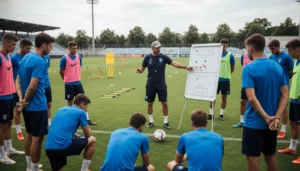
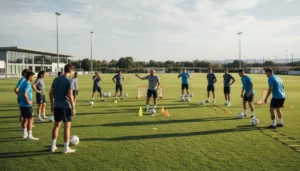
Use constrained small-sided games that force off-the-ball communication: impose a requirement that every pass must be preceded by a call, or add point bonuses for successful plays initiated by verbal cues. Run scenario-based drills (pressing triggers, counterattacks, defensive rotations) so calls are practiced within realistic decision windows.
These verbal foundations set you up to layer in non-verbal tools—gestures, eye contact and body orientation—which become crucial when noise or opponent pressure limits spoken instructions. In the next section, you will learn specific non-verbal signals and drills to combine them with the verbal system for seamless off-the-ball coordination.
Non-verbal signals: concise gestures, eye contact and body orientation
Non-verbal cues are the backup system when noise, distance or opponent pressure makes speech unreliable. Like your verbal vocabulary, your visual vocabulary should be small, unambiguous and practiced until automatic. Use these categories and examples as a starting point:
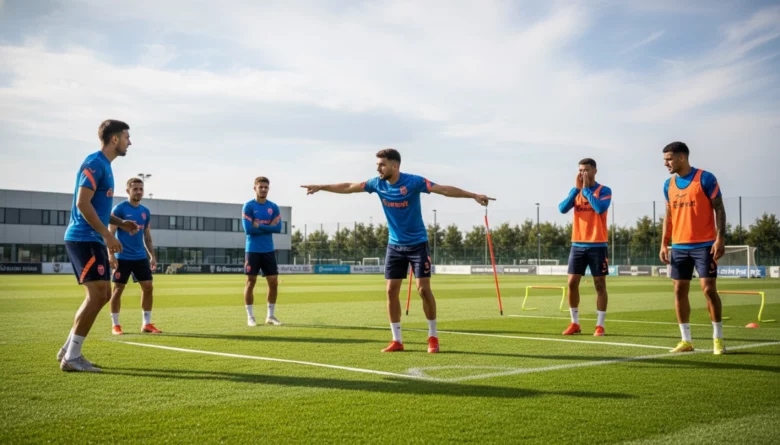
– Pointing and directional fingers: a single extended arm points where to move or pass; two quick taps to the chest plus an extended arm can mean “pass to me, into my feet.” Use a sweeping arm to indicate wider switches or overlaps.
– Palm signals for tempo and urgency: palm held up, fingers together = “hold/slow”; palm thrust forward = “go/accelerate”; flat palm down with chopping motion = “stay compact/close down.”
– Hand-to-ear or cupped hand = “I want the ball” or “I can receive”; keep it visible but brief.
– Shoulder and torso orientation: open your body toward the intended pass lane to show your target before you receive; square up to indicate a safe outlet; turn your back slightly to signal a decoy or a blind-side run is coming.
– Eye contact and glances: a deliberate glance toward space or a teammate seconds before a run is a subtle but powerful cue—train players to check and then signal, rather than rely on a single glance.
– Small rhythmic cues: claps or stomps can sync group movements (press triggers or collective line shifts) when voice calls are drowned out.
Important coaching points: exaggerate gestures in training so they’re visible under stress, then scale them down to realistic levels. Assign fixed meanings—every player must interpret a palm-up or shoulder-turn identically. Practice sending and receiving these signals under time pressure so interpretation becomes instinctive.
Drills to integrate verbal and visual communication under realistic pressure
Integration drills force players to combine spoken cues and gestures and to choose the most effective channel depending on context.
Progression framework:
1. Isolated repetition — practice a single non-verbal cue in controlled passing drills so players learn timing and visibility.
2. Paired combination — two players alternate between verbal call and matching gesture (e.g., say “time” + palm up) and must complete controlled switches under light pressure.
3. Constrained small-sided games — add rules that require a pre-pass signal (verbal or non-verbal) or award points for sequences started by a gesture rather than a shout.
4. Match-intensity scenarios — full-speed play with defenders, crowd noise playback, and limited communication windows to force reliance on visual cues.
Specific drills:
– Silent Possession: play 4v4 but ban all vocal communication for set intervals. Reward teams that maintain possession and complete organized rotations by using only gestures and body orientation.
– Call-and-Point Transition: when a coach blows the whistle, the ball-carrier must call (e.g., “overlap”) and the runner must point to the exact channel they’ll exploit. Successful completion earns the team a counter-attack.
– Press Trigger Mirror: defenders practice pressing triggers. Attackers use a pre-arranged hand signal to indicate a lay-off or turn; defenders mirror and react to the signal to practice coordinated pressing.
– Overlap on Cue: full flank play where overlaps are only allowed after the supporting player gives a visible palm or shoulder cue. This builds synchronicity between the runner and the carrier.
Feedback and measurement:
Video review highlights missed or successful cues. Track simple metrics: % of successful sequences started by non-verbal cues, decision time from cue to action, and turnovers caused by missed signals. Coach feedback should focus on timing (signals early enough to be acted on), consistency, and visibility—initially encourage large, clear signals and then refine them for match realism.
Combining these drills with your verbal drills creates a resilient communication system: when one channel fails, the other compensates, and together they raise collective speed and reduce errors off the ball.
From training to matchday — making it stick
Training communication off the ball is as much about culture as it is about technique. Make clarity, consistency and accountability everyday habits: build short rituals in warm-ups, appoint communication leads during sessions and matches, and review both success and failure with video so learning is continuous. For session plans, templates and stimulus ideas that scale across age-groups, see FA coaching resources.
Practical checklist for coaches
- Schedule regular micro-sessions (5–10 minutes) focused only on one cue or signal until it becomes automatic.
- Rotate leadership: let different players call drills and manage silence/gesture constraints to develop shared ownership.
- Use clear, measurable targets (e.g., % of successful sequences started by non-verbal cues) and review progress weekly with short clips.
- Create a simple team vocabulary chart and display it in the dugout or dressing room for quick reference.
- Gradually reintroduce realism: increase pressure, add noise, then reintegrate into full training and matches.
- Celebrate and reinforce correct communication in-game to build positive feedback loops—reward the habit, not just the outcome.
Small, consistent changes to how players talk and signal off the ball compound quickly. Commit to the process, measure what matters, and the team’s collective decisions will become faster, clearer and more effective when it counts most.