Why leadership training is essential for your team
You can coach technique and tactics, but the difference between a good side and a resilient, self-organising team often comes down to leadership. When players take ownership on and off the ball, they improve communication, speed of decision-making, and the ability to adapt when plans fail. Leadership training isn’t just for captains — it’s a pathway for more players to influence team culture, lift standards in training, and stabilize performance under pressure.
Define clear leadership objectives for every session
Before you step onto the pitch, decide which leadership behaviours you want to target. Keep objectives specific and measurable so you can observe progress. Example session aims you might choose:
- Improve on-field communication between defenders by increasing directional calls by 30% in small-sided play.
- Develop situational decision-making by having players call and execute a solution within five seconds of a prompt.
- Build accountability through rotating captaincy and peer-feedback checkpoints after drills.
By defining these outcomes, you make it easier for players to understand expectations and for you to measure the effectiveness of workshops and drills.
Practical workshop structure to teach leadership concepts
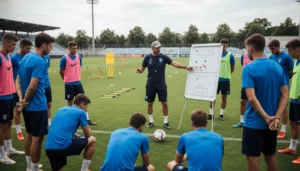
Your workshops should balance short classroom-style moments with immediate on-pitch application. Use a tight loop: explain a concept, show an example, practice it in a drill, then review. Keep the teaching blocks concise (5–10 minutes) and highly practical so players stay engaged and can relate concepts to match situations.
Essential components of an effective leadership workshop
- Context-setting (5 minutes): Pose a real match scenario that requires leadership — e.g., “We’re two goals down, 20 minutes to play.” Ask players what needs to change and who takes responsibility.
- Model behaviour (5 minutes): Demonstrate good communication, body language, and decision-making either via coach-led role play or video clips from matches.
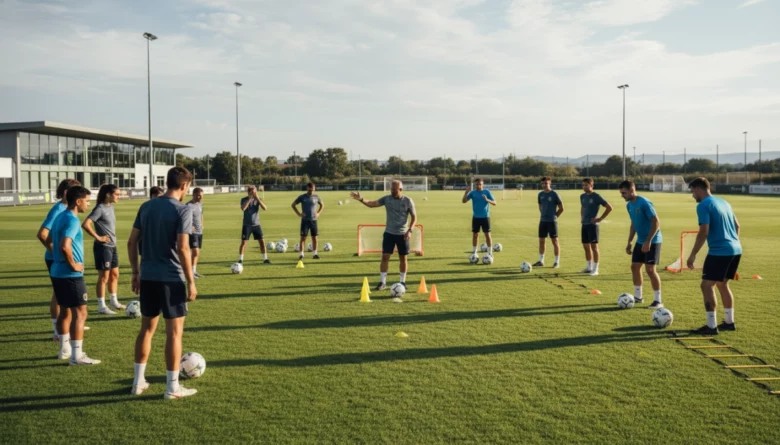
- On-pitch application (20–25 minutes): Use drills that force leadership choices, then switch roles to broaden experience.
- Reflection and feedback (5–10 minutes): Use guided questions and peer feedback to consolidate learning: “What did you decide? Why? What would you change next time?”
Design rules to keep workshops impactful
- Limit group size so everyone practices leadership opportunities regularly.
- Rotate responsibility — give multiple players the chance to lead in different contexts.
- Use objective metrics where possible (e.g., number of directives given, successful organisational calls) to track improvement.
With clear objectives and a tight workshop loop, you create a safe space for players to experiment with leadership while you gather evidence to guide next steps. In the next section you’ll find concrete drill templates — step-by-step progressions, coaching points, and how to adapt each drill for different age groups and ability levels.
Drill 1 — Structured small-sided game: “Control and Command”
Purpose: Force players to communicate, assign roles, and make quick organisational decisions under pressure.
Setup:
- Field: 30x20m (adjust size for age/ability).
- Players: 5v5 plus two neutral wide players (can be used by the team in possession).
- Duration: 3 x 6-minute rounds with 2-minute coach-led debriefs.
- Rule tweak: The team in possession must complete five passes before attempting to score; the defensive team must “reset” their defensive line by a vocal call (“line” or similar) after any turnover.
Progression (step-by-step):
- Round 1 — Baseline: normal play with the five-pass rule. Coach observes leadership behaviours without intervention.
- Round 2 — Leadership cue: designate two rotating leaders per team who must call organisation (who marks, who covers, who steps) after each transition. Coach awards a point for clear, timely calls.
- Round 3 — Time pressure: reduce the five-pass requirement to three and add a scoreboard that includes “leadership points” for successful commands that result in regained possession or prevented danger.
Coaching points:
- Encourage concise, auditable calls (“Mine”, “Left”, “Drop”) rather than long instructions.
- Reward initiative — players who quickly organise others after turnovers should receive immediate positive feedback.
- Note body language: leaders should face teammates, point to spaces, and show urgency without panic.
Drill 2 — Transition and responsibility: “Recover, Organise, Attack”
Purpose: Build leadership in moments of change — recovering shape, assigning marks, and initiating the next phase.
Setup:
- Field: Two boxes of 20x15m separated by a 10m neutral zone.
- Players: 7 attackers vs 7 defenders. When possession changes, attackers must retreat into their box and reorganise within 6 seconds.
- Duration: 4 x 5-minute rounds with role rotation.
Progression:
- Begin with coach controlling turnovers to create predictable transitions.
- Introduce a “recovery leader” role that must call shape and assign marks during the 6-second reset.
- Advance by adding a counter-press reward: if the recovery leader successfully organises a counter within 10 seconds, their team earns an extra attacking point.
Coaching points:
- Teach prioritisation: stop the immediate threat first (nearby attacker) before covering passing lanes.
- Use a stopwatch or verbal countdown to build a sense of urgency in the recovery leader.
- Rotate leaders so defenders, midfielders and attackers all practice organising under different constraints.
Adaptations, progressions and simple metrics to track development
Adaptations for age and ability:
- Under-12s: simplify language (use one-word calls), increase space and reduce player numbers to allow more time for decision-making.
- Teen/advanced groups: add tactical complexity — set-piece leadership, hidden leaders (no designated captain), or multi-tasking tasks (organise while receiving a pass).
- Players with lower confidence: start as a “communication assistant” role to give supportive instructions before full leadership rotation.
Progressions and overloads:
- Increase decision pressure by reducing time limits or numerical advantage.
- Introduce consequences for poor leadership (e.g., automatic corner awarded) to emphasise accountability.
- Move from coach-led prompts to player-generated scenarios as competence grows.
Measurable metrics to record each session:
- Number of clear organisational calls per leader per round.
- Successful defensive resets within the 6-second window (percentage).
- Impact actions: turnovers created or prevented as a direct result of leadership calls.
Use a simple checklist during drills and review video snippets in the reflection block. Over weeks, track trends rather than one-off results — rising call frequency plus improved defensive/reset success indicates genuine leadership growth.
Embedding leadership into your club culture
Developing leaders on the pitch is a long-game commitment: small, consistent practices create durable behaviours. As a coach, your role is as much about creating opportunities for leadership to emerge as it is about delivering instruction. Celebrate progress, normalise mistakes as learning moments, and protect the environment where players can try, fail and improve without fear.
Practical next steps for coaches
- Pick one clear leadership objective for the next four training sessions and record a single simple metric to track it.
- Introduce rotating responsibilities so multiple players get repeated leadership exposure each week.
- Build a short reflection routine at the end of each session—2–3 questions that prompt players to evaluate decisions and communication.
- Use video or peer feedback selectively to make leadership behaviours visible and coachable.
- Engage other staff and parents in supporting leadership development so it extends beyond training time.
For additional coaching frameworks and session ideas you can adapt, consult reputable coach education hubs such as the FA Coaching resources. Stay patient and deliberate: leadership growth is gradual but multiplies across a squad when given consistent attention.
Keep experimenting, keep measuring, and keep empowering players to take ownership—over time the cultural shift you build will be the most valuable result of your work.