Seeing the Game: Why developing tactical leadership changes outcomes
You already know that technical skill and fitness win moments, but tactical leadership determines how those moments combine into results. When players read the rhythm of a match, control tempo, and make smart choices under pressure, the team becomes resilient and adaptive. Coaching tactical leadership is less about dictating every pass and more about teaching players to interpret cues, communicate effectively, and take ownership of situational decisions.
On the pitch, tactical leaders do four things repeatedly: assess risk vs reward, organize teammates around priority objectives (defend a lead, regain momentum), manage time and tempo, and adapt game plans when the opponent changes shape. Your job as a coach is to create environments where those behaviours are practiced until they become instinctive.
Practical coaching methods to build in-game decision-making
Design small-sided scenarios that emphasize choices
Smaller formats accelerate decision-making by increasing touches and forcing quick transitions. Use constraints that simulate match trade-offs so players must choose between safety and opportunity:
- Numerical advantage/deficit drills: practice 3v2 and 2v3 sequences where the team in advantage must decide when to slow play or push for a goal.
- Time-limited possession games: give an attacking team 10 seconds to score, then extend to 20—players learn when to speed up tempo or recycle possession.
- Scoring incentive variations: award extra points for riskier plays (long switches, through balls) to encourage calculated risk-taking.
Teach communication routines and decision templates
Leadership is often verbal. You can formalize simple routines that reduce cognitive load during high-pressure moments:
- Use succinct calls: teach a limited set of words or signals for common needs (e.g., “Drop”, “Press”, “Leave”). Repetition in training makes them fluid in matches.
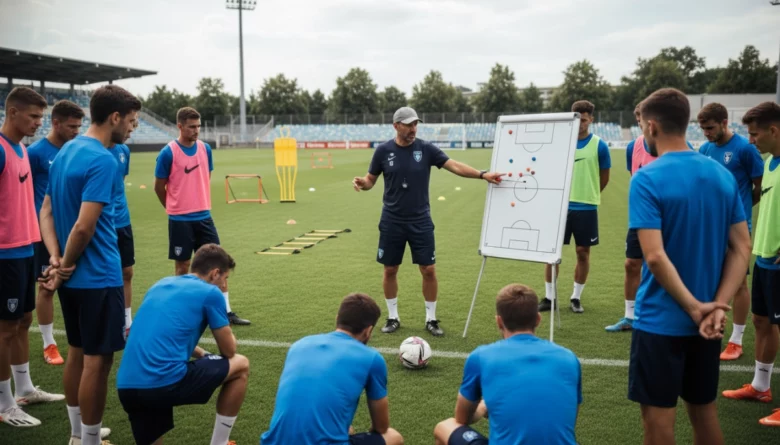
- Pre-match “if-then” plans: create short contingency phrases—if an opponent presses high, then play long; if trailing, compress lines. These templates guide quick choices without overthinking.
- Role-specific responsibilities: define what your captain, central midfielder, and full-backs must check first in possession. Clarity prevents overlap and hesitation.
Simulate pressure and time-management tasks
Game management often comes down to composure in late minutes or when protecting a lead. Rehearse these exact states so players internalize practical behaviors:
- End-of-game scenarios: practice 10-minute segments where the team defends a one-goal lead with re-entry opportunities for fresh legs and set-piece organization.
- Clock-awareness drills: add rules where time-wasting earns points for opponents or possession resets, forcing teams to learn how to legitimately manage the clock.
- Stress inoculation: introduce crowd noise, coaching distractions, or quick substitutions during drills to teach focus under disruption.
These foundational methods create a learning scaffold: players practice realistic choices, learn clear communication, and experience pressure in controlled settings. In the next section, you’ll get specific session plans and progressions that translate these principles into week-by-week training blocks.
A four-week progression to embed tactical leadership
Turn the principles into a repeatable block that builds complexity and transfers to matches. Below is a compact four-week progression you can slot into a typical pre-season or in-season microcycle. Each week has a clear focus, one measurable objective, and suggested session themes (2–3 sessions per week).
- Week 1 — Perception & Communication
Objective: Players consistently use the agreed verbal cues and “if-then” templates in 75% of coached reps.
Session themes: rapid-decision SSGs (3v3/4v4) with enforced call requirements; controlled build-out drills where one player must scan then call an option before receiving; video review of simple recognition moments.
- Week 2 — Risk Management & Tempo Control
Objective: Teams make deliberate tempo choices; measure by tracking number of purposeful slow-downs vs rushed mistakes.
Session themes: time-limited possession games that force tempo shifts; reward systems for completed recycling sequences; drills that punish careless long balls to encourage calculated risk.
- Week 3 — Transition Leadership & Adaptive Roles
Objective: Designated leaders trigger defensive/attacking shape adjustments within 3 seconds of turnover in 80% of reps.
Session themes: counter-attack and counter-press scenarios with leader rotation; role-specific checklists for midfield pivot, full-back, and captain during transitions.
- Week 4 — Match Integration & Pressure Testing
Objective: Transfer to competitive play—teams demonstrate improved game-management behaviours in intra-squad fixtures (measured subjectively and via simple stats: goals conceded after 75’).
Session themes: simulated match halves with scoreboard pressure, end-of-game rehearsals, captain-led tactical adjustments, and post-game player-led debriefs.
Two sample sessions you can run tomorrow
Make the progression real with repeatable session templates. Here are two sessions—one focused on decision speed and the other on defending leads—that fit into the weekly plan above.
- Session A — Fast Decisions (80 minutes)
- Warm-up (15′): Dynamic rondos with scanning requirement—players must call the next recipient and press start after scanning.
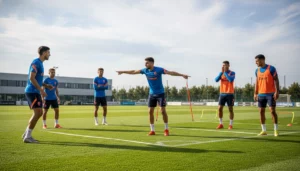
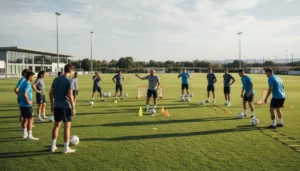
- Main (25′): 4v4 with three neutral support players. Attackers have 10 seconds to score; if they recycle and maintain possession for 20 seconds they earn bonus points. Coaching focus: tempo choice, scanning, communication.
- Conditioned game (30′): 8v8 on a reduced pitch. Introduce “one-touch zones” where decisions must be immediate. Rotate leaders every 10 minutes to practise directive communication.
- Debrief (10′): Two-minute player reflections (what decision was hardest?) + coach feedback.
- Session B — Protect the Lead (75 minutes)
- Warm-up (10′): Shape retention drills—compactness and shifting with vocal cues.
- Main (30′): End-of-game scenario: team defends a one-goal lead for 12 minutes against fresh attackers; defenders can sub in only twice. Coaching focus: time management, set-piece organisation, controlled clearances.
- Small-sided finish (25′): 6v6 with a rule that conceding resets the lead team’s extra points—reinforces urgency and composure.
- Debrief (10′): Video clip of a key moment + players propose a different in-game choice and coach moderates.
Measure, adapt, and hand leadership back to players
Practice alone won’t stick unless you measure and adjust. Use simple metrics (decision latency, successful risk conversions, goals conceded after the 75th minute) and combine them with qualitative tools: captain logs, short post-game leader meetings, and quick video snippets highlighting choices. Coach less during games as the block progresses—prompt questions instead of answers (“What do we lose if we take the risk?”). The aim is to shift responsibility toward players so tactical leadership becomes a collective, practiced habit rather than a coach’s instruction.
Putting leadership into practice
Tactical leadership is a habit built over repetitions, not a one-off talk. Keep experiments short, measure what matters, and return ownership to players so the behaviors survive the training ground and show up when the whistle blows. Expect setbacks and treat them as data for refinement rather than failure.
Next steps for coaches
- Start one small rule or cue this week (e.g., a single verbal template) and reinforce it across sessions.
- Collect one simple metric (decision latency, late goals conceded) and one qualitative note (captain log) after each match to guide adjustments.
- Rotate leadership roles regularly so multiple players practice making in-game calls and adapting shapes.
- Rehearse pressure states frequently—end-of-game drills, noisy distractions, and quick substitutions—to build composure by design.
If you want additional frameworks and session ideas, explore practical coach education materials such as the FA Coaching resources to expand your toolbox and adapt methods to your squad’s level. Keep experimenting, stay patient, and let players carry the tactical load so your team becomes smarter, not just fitter or faster.