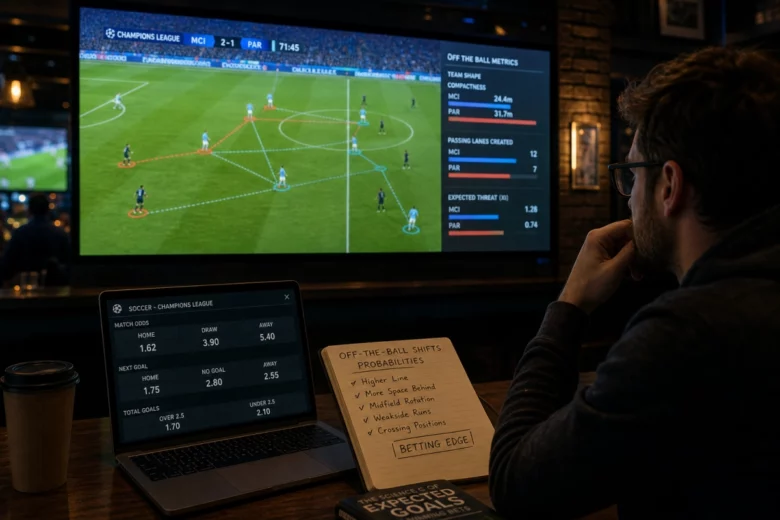
Why football Off-the-Ball Players matter for betting markets
Most casual bettors focus on obvious stats: shots, key passes and possession. Yet subtle actions by football Off-the-Ball Players — timed runs, rotations, creating space, coordinated pressing and disciplined positioning — regularly shift the probability of goals, assists and match outcomes. Understanding these movements gives bettors an edge when assessing markets such as match result, over/under goals, both teams to score (BTTS), player assists/secondary assists and live (in-play) odds.
How specific off-the-ball behaviours change probabilities bettors should track
Below are common off-the-ball behaviours and the practical market effects a bettor can expect. Each entry explains the tactical effect, the statistical consequence and which markets are most sensitive.
Timed runs and penetrating movement
- Tactical effect: Well-timed diagonal or forward runs split defences and generate higher-value chances inside the penalty area.
- Statistical consequence: Increases expected goals (xG) for the attacking side and raises the probability of a goal in the immediate sequence.
- Market impact: Moves over/under odds upward for “over” goals and increases BTTS likelihood; also raises odds for individual player assists and secondary-assist markets if bookmakers list them.
Rotations and overloads
- Tactical effect: Midfield or front three rotations create numerical advantages and open channels for shots from distance or cutbacks.
- Statistical consequence: Greater chance of high-quality shooting opportunities and sequence-based xG spikes.
- Market impact: Pre-match models that account for a team’s rotational play may shorten match-winner odds; in-play, accumulators with goal-related legs become likelier to hit when rotations consistently create chances.
Space creation and decoy runs
- Tactical effect: Players who draw markers away create space for teammates — often increasing expected assists for specific creators and finishers.
- Statistical consequence: Assists and secondary-assist probabilities rise even when the decoy doesn’t touch the ball.
- Market impact: Player assists markets and anytime-scorer odds can shift when a lineup features consistent space creators. Bettors should watch likely starting XIs and role descriptions.
Pressing triggers and positional discipline
- Tactical effect: Collective pressing triggers lead to turnovers high up the pitch; positional discipline prevents counter vulnerabilities.
- Statistical consequence: Increases short-term scoring spikes (after turnovers) but reduces conceded chances on counters.
- Market impact: In-play odds respond quickly: aggressive pressing increases immediate goal expectancy (shortening odds for next-goal markets) while strong discipline keeps match-result and Asian handicap markets more stable.
Practical signals bettors can monitor pre-match and during live play include starting positions, recent heatmaps, substitution patterns, known pressing intensity and whether a manager favours rotations. Remember to factor in form, injuries and fatigue alongside tactical cues, and always stake responsibly within a set budget.
Next, the article will show how to quantify off-the-ball impact using metrics (xG timeline, progressive runs, second assists) and illustrate with clear pre-match and in-play examples to guide market selection and timing.
Quantifying off-the-ball impact: the metrics that matter
To move from intuition to actionable bets you must translate off-the-ball actions into measurable signals. Bookmakers price using a huge dataset; bettors who track a handful of reliable metrics can spot deviation and value. Key metrics to prioritise:
- xG timeline and sequence xG: not just match xG but the distribution across sequences. A team with low total xG but repeated short-term spikes (several sequences >0.2 xG) is more likely to convert in-play than one with a single isolated chance.
- Progressive runs / carries: event counts for players who consistently move the ball into dangerous areas. Higher progressive-run rates correlate with increased shot volume and sustained pressure — useful for over/under and next-goal markets.
- Touches in the box and penalty-area entries: off-the-ball movement that leads to receiving the ball inside the box is a direct precursor to high xG chances. Track per-90 rates and whether players maintain those rates against top opponents.
- Secondary-assist (hockey assist) frequency: decoy runs and rotations often create the second pass. A rising secondary-assist rate for particular midfielders or wingers signals enhanced assist probability for teammates.
- Pressure regains / turnovers in attacking third: pressing-trigger metrics indicate short-term goal expectancy jumps. High pressure-regain teams create multiple high-probability sequences per match.
Sources: Opta, StatsBomb, Wyscout and FBref/Understat offer these event-level stats; many bookmakers’ in-play models implicitly use them. For bettors without paid feeds, combine public xG timelines (Understat), heatmaps (WhoScored/FBref), and match summaries to approximate these signals.
Interpretation tips: weight recent form (last 3–5 matches), minutes played (substitutes produce fewer runs), and opponent context (a travelling full-back will have different space to exploit against a high defensive line). Normalize metrics to opponent difficulty — 0.5 progressive runs against a low-block side is not the same as 0.5 against a high-pressing team.
Applying metrics to pre-match and in-play decisions
Metrics become profitable when they map to specific market moves. Here are concrete scenarios and how to act:
- Pre-match: backing Over/BTTS when progressive runs + box touches align
If team A averages high progressive runs and box entries while team B concedes lots of penalty-area entries and has low defensive rotations, the pre-match market underpricing of over goals is common. Target Over 2.5 or BTTS when combined with starting XI confirmation (e.g., an attacking full-back starting). If odds imply a 45% chance but your model — factoring progressive runs and opponent vulnerabilities — shows 55%+, you’ve found value. - Pre-match: player-assist and secondary-assist markets
When a creative midfielder has elevated secondary-assist rates and a focal striker consistently makes decoy runs, the listed assist odds for the midfielder shorten slowly in-play. Backing the midfielder pre-match (or as in-play volume builds) can beat late market adjustments because bookmakers are slower to price second assists. - In-play: exploiting pressing-trigger spikes for next-goal and short handicaps
Watch the xG timeline and pressure-regain events. A sustained cluster of turnovers in the opponent’s box frequently precedes a goal within the next 5–12 minutes. If live odds for “next goal” or a +0.5 Asian handicap haven’t shortened proportionally, a small, time-limited stake can be justified. Exit quickly if the sequence fizzles or the opposition resets shape. - Substitution windows and rotation cues
Substitutes who specialise in penetrating runs or whose heatmap shows late-match forward rotations increase goal probability late in matches. When managers bring those players on and the defense is fatigued, consider late Over/BTTS or player-anytime-scorer lines if odds still reflect starting-XI assumptions.
Finally, always combine metric signals with context: match state, weather, referee tendencies and squad news. Off-the-ball data gives you the directional edge; disciplined sizing and quick execution convert that edge into sustainable value.
Putting the edge into practice
Turn the tactical signals into repeatable actions: build a simple pre-match checklist, set a small list of in-play triggers you trust, and keep stakes proportionate to the expected edge. Focus on one or two markets while you learn how off-the-ball movements translate into value — for example, next-goal/short Asian handicap in-play or player-assist lines — and avoid overextending into unfamiliar markets.
- Pre-match checklist: confirm starting XI and roles, compare progressive runs/box entries to opponent vulnerabilities, and check whether rotation/pressing styles are likely to persist given fatigue or squad news.
- In-play triggers: act on sustained pressure-regain clusters, repeated sequence xG spikes, or substitutions that introduce known space-creators/penetrators; be prepared to exit quickly if the sequence collapses.
- Execution rules: size bets to a predetermined percentage of your bankroll, limit live exposure time (e.g., 5–15 minutes after a trigger), and avoid chasing losses driven by emotion rather than signals.
- Data and review: log each trade with the signal that prompted it and the outcome so you can refine which off-the-ball cues reliably create value.
Final thoughts for disciplined bettors
Off-the-ball movements are a subtle, durable source of edge because they’re often under-priced by market-makers and less visible in headline stats. That edge pays off only with disciplined implementation: test ideas with small stakes, keep clear records, and iterate your rules based on what your own data shows. Treat this as a skill — not a shortcut — and combine tactical reading with sound bankroll management and emotional control. Over time, small, consistent advantages found in runs, rotations and pressing patterns compound into a measurable improvement in returns.