
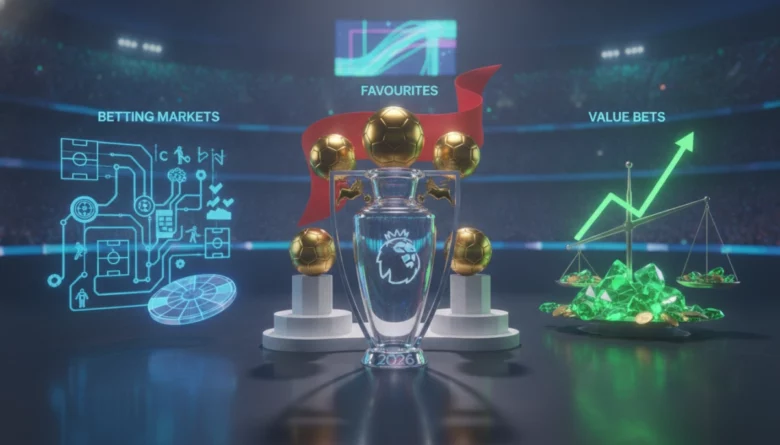
How Premier League 2026 odds shape your betting approach
You’re likely checking Premier League 2026 odds because you want to make informed wagers rather than rely on gut feeling. Odds are more than a price — they’re a snapshot of market sentiment, bookmaker liability and, often, public money flow. Understanding what odds reflect (and what they hide) helps you spot when the market has overreacted or under-reacted to transfers, injuries or managerial changes.
Bookmakers update lines in real time as new information arrives, but you’ll also see movements driven purely by betting volume. When a heavy favourite shortens, it could be because large stakes from professional bettors have signaled genuine edge, or simply because a large public stake skewed the market. Your job is to separate noise from signal: compare early prices, monitor consensus movements and use implied probability to judge whether a price represents value for you.
Reading the markets: favourites, contenders and when to act
Different markets you’ll encounter
- Title odds — the headline market. These usually have the deepest liquidity and fastest-moving prices.
- Top-four / top-six — useful if you prefer conditional bets; movement here can differ from the outright title market.
- Relegation and player markets — these can offer value when you spot discrepancies between team form and individual stats.
Each market answers a different question. If you want exposure to a team’s long-term project (transfers, manager continuity), the title market is appropriate. If you think a team will outperform for a single season but not win the title, top-four or top-six might be a smarter play.
Who looks favourite and why early in the campaign
At this stage you’ll usually see a small cluster of favourites — historically, established top-six clubs will dominate the shortest prices. Odds are influenced by recent success, squad investment in transfer windows, and perceived managerial stability. You should watch for three signals:
- Transfer activity: big signings often shorten a club’s odds immediately, but you need to judge fit and fatigue risk.
- Managerial changes: a new coach can create a short-term spike in interest; sometimes that’s a genuine improvement, sometimes it’s honeymoon optimism.
- Injury reports and preseason form: these nudge markets but rarely tell the whole story; small-sample preseason results can mislead you.
Value often appears where the market is slow to adjust — for example, when a promoted side strengthens sensibly but remains priced as a clear underdog, or when a big club loses a star player and the market underestimates the drop-off. You’ll want to convert odds into implied probability (and factor in the bookmaker margin) to see if a bet returns positive expected value for you.
In the next section, you’ll get a practical walkthrough of calculating implied probabilities, spotting overrounds, and identifying specific value bets among the current 2026 lines.
Calculating implied probability and spotting the overround
Before you bet, convert prices into implied probabilities — it’s the only objective way to compare market prices with your own view. For decimal odds the conversion is simple: implied probability = 1 / decimal odds. So a 3.00 price implies a 33.33% chance, a 6.00 price implies 16.67%.
Bookmakers build a margin into markets, so the sum of implied probabilities will usually exceed 100% — that excess is the overround (the bookmaker’s edge). Example: a three-way match priced 2.50, 3.20 and 3.10 converts to implied probabilities of 40.0%, 31.25% and 32.26% respectively, totalling 103.51% — an overround of ~3.5%. Recognising that lets you normalise the book and compare apples to apples.
To normalise, divide each implied probability by the total implied probability. In the example above the normalised probability for the 2.50 outcome would be 40.0 / 103.51 = 38.6% — a better reflection of the market’s “true” consensus after removing margin. Value occurs when your assessed probability for an outcome exceeds the market’s implied (or normalised) probability.
Finally, convert value into expectation. You don’t need a perfect forecast — compare your probability to the implied probability and calculate expected value (EV). A quick EV check: EV = (your_prob * decimal_odds) – 1. If EV > 0 the bet is, in principle, profitable over the long run.
How to identify specific value bets in the 2026 markets
Finding real value is about patterns, not hunches. Here are recurring edges in Premier League title/top-four and related markets this season:
- Underpriced promoted sides — teams that strengthened in the summer but remain priced like typical promotees. If you’ve reviewed recruitment and see clear upgrades in defence or goalscoring, the market can be slow to adjust.
- Managerial uncertainty — the market often overvalues the honeymoon period for a new manager and undervalues continuity. Conversely, if a long-term coach survives a poor start and the market prices them in as a write-off, that can be mispriced.
- Player props that reflect system fit — the Golden Boot or assists markets can underprice a forward moved into a central role at a mid-table side where they’ll get more service.
- Top-four / top-six conditional value — sometimes a club’s title odds are long, but top-four odds are reasonable; backing a top-four finish can give better value if you think regression to the mean is coming.
Apply the maths: imagine you assess Team X’s chance of winning at 25% but the market has them at 6.00 (16.67%). That’s value — your probability (25%) > market implied (16.67%). Use a staking plan rather than staking arbitrarily: the Kelly criterion gives a mathematical stake size (Kelly = (b*p – q)/b, where b = odds-1, p = your probability, q = 1-p). With odds 6.00 (b=5) and p=0.25, Kelly = 10% of bankroll; most pros use a fraction (¼–½ Kelly) to reduce volatility.
Timing, sizing and monitoring — practical rules to act on value
Value is perishable. Bet early when you’re confident — markets often shorten on public money and news — but don’t rush before verifying injuries and tactical fit. Conversely, wait for overreactions: an early-season loss or a short-term injury can create inflated prices that snap back once context returns.
- Shop lines across bookmakers and use exchanges for better liquidity on large bets.
- Set alerts for price moves >10–15% on markets you follow; sharp moves often reveal where smart money is going.
- Size conservatively: prefer many small value edges to betting big on one conviction. Use fractional Kelly or a flat-percent approach to control drawdowns.
With these tools — converting odds correctly, isolating systematic market biases in 2026, and timing stakes prudently — you turn Premier League odds into a repeatable advantage rather than a gamble.
Final steps before you stake
Now that you’ve worked through the mechanics of odds, implied probability and value identification, the most important moves are practical and behavioural. Before placing money: verify late team news, confirm prices across multiple firms, size stakes to protect your bankroll, and set alerts so you can act when markets move. Treat every selection as part of a process — discipline and record-keeping separate long-term winners from short-term luck.
Practical checklist
- Verify last-minute team and injury updates before bet placement.
- Shop around for the best price or use an exchange to reduce margin impact.
- Convert odds to implied probability and check for positive expected value.
- Use a staking plan (fractional Kelly or fixed-percentage) and stick to it.
- Set price-move alerts and limit exposure on single-event concentration.
- Keep a betting ledger and review performance periodically to refine your edge.
- Know the rules and legal limits in your area and seek help if gambling becomes a problem — for support see GambleAware.
Parting thought
Betting the Premier League should be methodical, cautious and patient — treat odds as information, not certainty. When you combine disciplined money management with careful market reading, you give yourself the best chance of turning short-term opportunities in the 2026 markets into sustainable advantage.