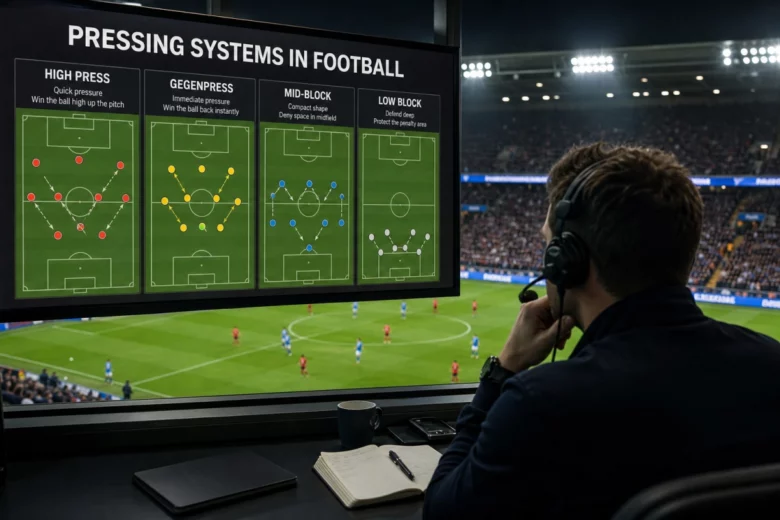
Pressing systems in football: how they shape matches and betting markets
Why pressing systems matter to bettors
Pressing systems in football are among the clearest predictors of how a match will be played. A team that presses aggressively forces turnovers in dangerous areas, raises the game’s tempo and often produces more shots, corners and set-piece incidents. Conversely, a team set up in a deep low block invites possession but can create low-scoring, low-volatility contests.
For bettors the practical value is simple: spotting the likely pressing system helps select appropriate markets — match result, over/under goals, both teams to score (BTTS), corner and card markets, and live (in-play) strategies. Below are clear, usable ways to spot pressing intent before kick-off and confirm it with measurable stats.
Reading formations and manager profiles to identify pressing intent pre-match
Start with formation and manager type. Certain formations and coaching philosophies signal pressing systems:
- High press / Gegenpress archetype — common with dynamic front threes or midfield threes (e.g. 4-3-3, 4-2-3-1 when full-backs push high). Managers who prioritise turnover hunting, aggressive transitions and quick counter-attacks typically use these systems.
- Counter-press (gegenpress) — a variant of high press where the immediate goal after losing possession is to win the ball back within a few passes. Expect quick shots from regained possession and frequent short, high-intensity attacking phases.
- Mid-block — a compact shape around midfield (e.g. narrow 4-4-2 or 3-5-2) that presses selectively. Mid-blocks balance risk and control; they can produce moderate shot volumes and more structured counter-attacks.
- Low block — deep defensive lines (often with two banks of four) prioritise compactness and concede possession. These matches can trend toward fewer shots and lower goal totals but higher set-piece counts if the defensive side relies on clearing crosses.
Manager profiles matter: some coaches are known for relentless pressing, others for possession control. Pre-match notes to check: starting XI (are wingers and full-backs pushed forward?), recent tactical changes, and whether key pressing players are fit.
Measurable stats to confirm pressing: PPDA, turnovers and pressing intensity
Use data to move from hunch to evidence:
- PPDA (Passes Per Defensive Action) — lower PPDA indicates more aggressive pressing (fewer passes allowed before a defensive action). Compare teams’ PPDA in recent matches and league averages to judge relative pressing intensity.
- Turnovers and high turnovers in final third — teams that win the ball high up create immediate chances; track turnovers per 90 and turnovers in attacking zones where available.
- Pressing intensity and pressures leading to shots — metrics that link pressures to shot events show how often pressing directly creates chances. Higher values point to markets like over 2.5 goals or BTTS being more likely.
Quick definitions for bettors: Over/Under goals bets predict total match goals; BTTS is whether both teams score; corner and card markets track set-piece/count events; in-play volatility refers to how quickly odds move during a match. Recognising pressing patterns helps choose which of these markets to target and when to move from pre-match to live bets.
Next, the guide will examine each pressing system in detail — tactical characteristics, how they show up in stats and lineups, and concrete examples of how they tend to influence specific betting markets.
High press and counter‑press — what to look for and market signals
The high press and its immediate cousin, the counter‑press (gegenpress), are the clearest catalysts of high‑tempo, high‑volatility matches. Tactical signs pre‑match: narrow 4‑3‑3 or an aggressive 4‑2‑3‑1 with full‑backs high, a mobile front three, and midfielders whose heatmaps sit between opposition lines. Manager profile flags — coaches who favour quick transitions and recovery pressing — strengthen the signal. Stat confirmations: a PPDA substantially below league average (top pressing teams often sit well under typical league PPDA), high pressures per 90 and a noticeable number of turnovers in the attacking third or final 30 metres.
How that moves markets
– Over/Under goals & BTTS: these systems usually push over 2.5 and BTTS probability up. Quick turnovers create immediate shots and chaotic sequences.
– Corners: more shots and forced clearances translate to more corners for both sides.
– Cards: higher intensity and more tactical fouls near the box drive card markets up.
– In‑play volatility: expect rapid swings in odds — a single regained possession can produce a big chance; live overs and BTTS live entries often pay well in the first 25 minutes.
Practical betting cues
– Pre‑match: back overs/BTTS when a pressing side with low PPDA faces a mid/low‑block team that historically concedes shots from turnovers.
– In‑play: if pressures and turnovers concentrate high up early, target 15–30 minute over markets or live BTTS. If key pressers are substituted or visibly tired, pull back — pressing is energy dependent.
Mid‑block — the balanced, swing system and its betting fingerprints
Mid‑blocks sit in the middle: compact through midfield, selective pressing, smart counters. Formation cues include narrow 4‑4‑2 or 3‑5‑2 with wingbacks dropping to form a midfield bank; teams look to frustrate rather than hunt every ball. Stat patterns: PPDA close to league average, moderate pressures per 90, and controlled turnover numbers (fewer frantic turnovers high up).
How that moves markets
– Over/Under goals & BTTS: typically produce mid‑range totals — over 1.5 is common, over 2.5 and BTTS are more situational, depending on the opponent’s pressing.
– Corners & cards: moderate volumes; corners spike when a mid‑block concedes sustained possession in wide areas.
– In‑play volatility: steadier than high‑press games, but vulnerable to sudden shifts when a counter‑attacking team breaks through.
Practical betting cues
– Pre‑match: favour conservative markets (under 3.0, match result) unless the opposition is a prolific press. Look at relative PPDA and turnovers — a press vs mid‑block is often a good over/BTTS angle.
– In‑play: monitor successful counter‑attack events and full‑back positioning; a late push from the mid‑block team for a result can create value in second‑half corners and injury‑time goal lines.
Low block — defensive resilience, set‑piece markets and late odds movement
Low blocks park deep, concede possession and invite crosses and set plays. Formation and lineup signs: two banks of four, defensive full‑backs, a lone striker or compact front two. Stat signatures: high PPDA (they allow many passes), low pressures per 90, and few turnovers in the opponent’s half.
How that moves markets
– Over/Under goals & BTTS: tend to suppress totals and BTTS probability; unders and single‑team clean‑sheet markets often look attractive.
– Corners & set pieces: attacking sides generate more corners; low‑block teams themselves rarely do. Expect higher corner lines for the offensively dominant side.
– Cards & in‑play volatility: more fouls in dangerous areas and tactical time‑management late on can push card counts up; volatility often spikes late if the attacking team grows desperate.
Practical betting cues
– Pre‑match: consider under/BTTS‑no when a proven low block faces a non‑pressing opponent. Lay overs if the attacking team lacks penetration metrics (low shot‑creating actions).
– In‑play: if sustained wide possession fails to produce shots or big chances, reduce exposure to live overs; conversely, a late attacking substitution can temporarily increase corner/shot markets — a short, targeted live bet can pay.
Quick in‑play triggers to act on
- Early concentration of turnovers high up (first 20–30 minutes): consider short‑term overs or BTTS if the attacking team sustains pressure.
- Visible formation shift or personnel change (full‑back pushed higher, extra forward introduced): reassess corner and shot markets immediately.
- Key presser substituted or visibly fatigued: reduce exposure to live over/BTTS lines — pressing is energy dependent.
- Prolonged sterile possession without shots against a low block: avoid chasing live overs; pivot to corners or cards if the attack becomes more direct.
- Red card or early injury to a central midfielder: expect PPDA to swing and volatility to rise — live markets often misprice this shift for a short window.
Putting pressing systems to work
Treat pressing systems as a practical lens rather than a strict formula. Use formation cues, manager tendencies and measurable stats to build probabilistic views, then back those views with disciplined bankroll rules and clear exit criteria. Combine pre‑match research with live observation: the best edges appear when data and on‑pitch signals converge.
Keep simple rules: bet smaller when signals are weak or ambiguous, increase size only when multiple indicators align, and log every trade so you can learn which pressing cues produce reliable value. Pressing systems shape opportunity — your job is to turn those opportunities into repeatable, controlled decisions.