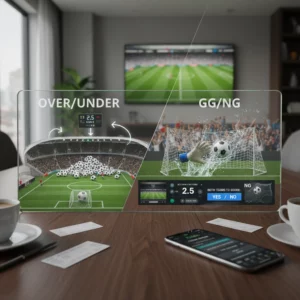

Why GG/NG Picks and Match Winner Predictions Can Improve Your Daily Betting
You want a repeatable method that turns raw match information into smarter daily football betting decisions. Focusing on two complementary markets—GG/NG (Both Teams to Score / No Goal) and Match Winner predictions—gives you flexibility. GG/NG bets target scoring patterns and defensive vulnerabilities, while Match Winner selections force you to assess probabilities and value in the odds. Together they let you diversify risk across outcomes and exploit different edges in the market.
How these markets fit into a practical betting routine
- You can use GG/NG as a hedging tool when the favorites are strong but both teams tend to score.
- Match Winner bets are ideal when one team’s probability materially exceeds the implied odds.
- Combining a conservative GG/NG stake with a more confident Match Winner selection helps manage variance across daily bets.
How GG/NG Picks Work and What You Should Check First
GG (Both Teams to Score) and NG (No Goal / One team keeps a clean sheet) markets are straightforward, but their predictive power hinges on a few measurable factors you can check quickly.
- Recent goal frequency: Look at the last 6–8 matches for each team—if both average 1.2+ goals per game, GG becomes likelier.
- Head-to-head trends: Some matchups routinely produce goals or low scores; historical H2H can reveal stylistic clashes.
- Starting line-ups and rotation: Missing key defenders or attacking midfielders swings the GG/NG balance heavily.
- Expected Goals (xG) and conceded xG: These metrics show underlying quality beyond raw goals—high xG conceded raises GG probability.
- Game context: Cup ties, late-season relegation battles, and games with one team already eliminated often change scoring incentives.
Assessing Match Winner Predictions: What You Must Analyze
When you make a Match Winner prediction, you’re estimating which outcome the market underprices. To do that reliably, check a compact set of variables that matter most to probability assessments.
- Form and momentum: Recent results, but weight underlying performance (xG and defensive solidity) higher than last-minute scorelines.
- Home advantage and travel: Some teams drop significantly away from home; travel fatigue or altitude can be decisive.
- Injuries and suspensions: Missing a playmaker or central defender often alters both match-winning chances and GG/NG prospects.
- Motivation and scheduling: Fixture congestion or prioritised competitions change team selection and intensity.
- Market movement and value: If odds shorten, ask why—sharp money, public bias, or late team news? Only back value.
Follow these checks to filter matches quickly and build a shortlist for your daily bets. Next, you’ll learn how to convert these assessments into actual pick examples, staking rules, and a sample daily card to follow.
Converting Your Shortlist into Concrete Picks
With a filtered shortlist in hand, the next step is translating qualitative reads and metrics into concrete bets you can place quickly. Use a simple decision flow to keep selections consistent and repeatable:
- Step 1 — Choose the market first: For each shortlisted match decide whether GG/NG or Match Winner offers the clearest edge. If both teams show high attacking output and defensive frailty, GG is primary. If one side shows a clear probability advantage after adjusting for lineup and context, favour Match Winner.
- Step 2 — Apply objective thresholds: Convert your checks into rules. Examples: back GG if both teams’ average goals-for in the last 6 matches ≥1.2 and conceded xG ≥1.0; back a Match Winner when your assessed win probability exceeds the implied market probability by ≥5% (or the fair-odds edge translates to >+10% value over the bookmaker price).
- Step 3 — Cross-check late variables: Confirm starting XIs, weather, and late suspensions 60–90 minutes before kick-off. If a late change undermines your criteria (a top striker rested, or a centre-back ruled out), drop or downgrade the pick.
- Step 4 — Record rationale: Jot one-line reasons for each pick (e.g., “Home win — favourite + key opposition defender suspended; market still overprices away resilience”). This builds a discipline that helps refine rules over time.
Practical Staking Rules for GG/NG and Match Winners
Staking is where theory meets psychological discipline. Use a simple, low-maintenance model if you bet daily to avoid overcomplicating decisions.
- Base unit and exposure: Define a base unit (1% of bankroll is common). Limit total daily exposure to a small fraction (3–6 units) to keep variance manageable.
- Market-differentiated sizing: Treat GG/NG as lower-variance: typical stake 0.5–1 unit. Treat confident Match Winner picks as higher conviction: 1–2 units depending on edge size.
- Fractional Kelly for value bets: If you estimate probability precisely, use a fractional Kelly (10–25%) to scale stakes relative to edge. For most daily bettors a fixed-unit system with occasional 2x stakes for clear value is simpler and effective.
- Combining bets and correlation: Avoid stacking highly correlated bets (e.g., multiple bets on the same league’s outcomes) that magnify variance. If you pair GG and a Match Winner in the same game, reduce combined stake to keep risk in check.
- Loss control: Set a daily loss limit (for instance 6–8 units). Stop betting when you hit it—taking losses is part of long-term survival.
Sample Daily Card and In-Play Management
Here’s an example framework for a single-day card (illustrative, not actual picks):
- Match A: GG at 1.85 — stake 0.75 unit (both sides with high xG and two weakened backlines)
- Match B: Home Win at 2.10 — stake 1.0 unit (market underestimates home motivation + suspension to away CB)
- Match C: NG at 2.20 — stake 0.5 unit (favoured defensive unit vs rotated attack)
In-play management rules:
- Pre-assign reactions: Decide before kick-off whether you’d cash out, hedge, or hold if the game goes to plan or deviates (e.g., red card early).
- Watch trigger events: Lineup confirmation, early red cards, and weather changes are legitimate reasons to hedge or exit. Goals rarely justify emotional overreactions—refer back to your pre-assigned plan.
- Use partial hedges: If a Match Winner bet looks shaky after the first 30 minutes, consider a small lay on a betting exchange or a low-stake counter-bet to protect capital without wiping out profit potential.
These practical picks, staking rules, and in-play protocols turn your shortlist into an actionable daily routine that balances value hunting with risk control.
Putting the System into Practice
Discipline and repetition are what separate a loose idea from a repeatable betting process. Treat each day as a single experiment: shortlist, apply objective thresholds, size bets according to your staking rules, and stick to pre-assigned in-play decisions. Build a simple record (date, match, market, stake, odds, outcome, one-line rationale) and review it weekly to spot patterns—both strengths to scale and leaks to plug.
Start small while you validate the edges you think you have. Use the unit sizes and limits described earlier to keep variance tolerable, and only scale when the process shows positive expectancy over a meaningful sample. When you need market context or quick odds checks, use reliable odds comparison tools like odds comparison tools to verify prices before committing.
Finally, accept that losing runs are part of the game. Your job is to manage risk, preserve bankroll, and continuously refine the decision rules that produce long-term value. Keep the process simple, keep the record clean, and let objective criteria—not emotion—drive the bets.
Frequently Asked Questions
When should I prioritise a GG/NG pick instead of a Match Winner?
Prioritise GG when both teams show consistent attacking output and defensive frailty (for example, both teams averaging ≥1.2 goals-for over recent matches and conceded xG around or above 1.0). Choose Match Winner when one side retains a clear adjusted probability edge after accounting for lineups, motivation, and suspensions—aim for an assessed edge ≥5% over market-implied probability.
How should I size stakes when combining GG and a Match Winner in the same game?
Because those bets are correlated, reduce combined exposure. Treat GG as lower-variance (0.5–1 unit) and Match Winner as higher conviction (1–2 units), but if you place both on the same game cut the total stake (for example, reduce each by 25–50%) so your aggregate risk remains within your daily exposure limit (3–6 units).
How often should I review my thresholds, staking, and overall process?
Review records weekly for tactical adjustments (lineup patterns, market moves) and run a more thorough performance review monthly or quarterly to reassess thresholds and staking. Use small samples only to spot obvious errors; require a meaningful sample size before permanently changing a core rule. If you consistently miss your projected edge, pause scaling and diagnose whether the issue is selection, sizing, or market pricing.