
Choose the right goals market by matching tempo and context
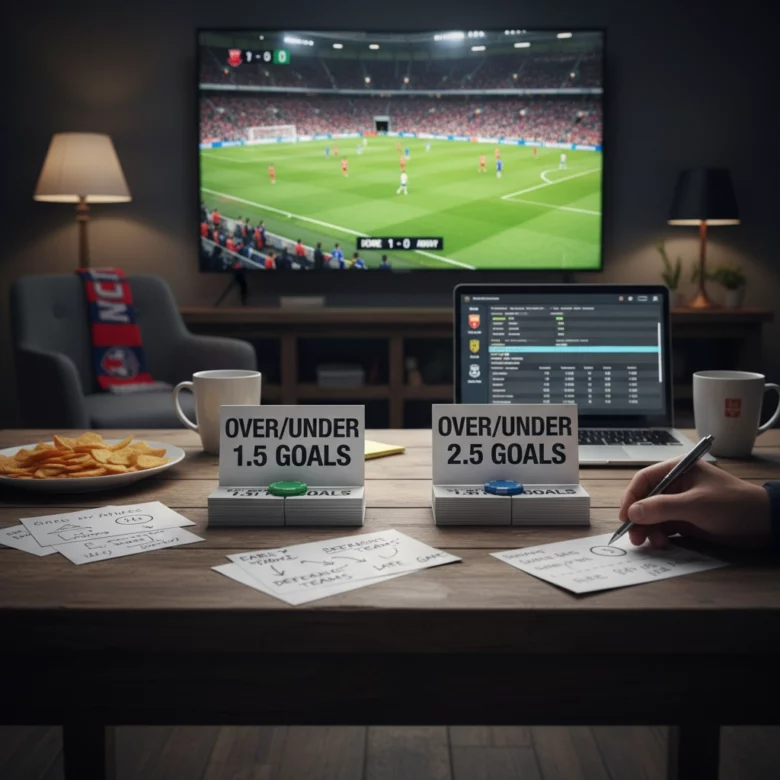
You can make quicker, more reliable betting decisions when you understand what each goals market actually measures. Over/Under 1.5 and 2.5 are two of the simplest markets: they ask whether a match will produce at least 2 or 3 goals respectively. But knowing the numeric threshold isn’t enough. You need to read game tempo, team intent, and match context so your wager aligns with probability rather than hope.
How Over/Under 1.5 differs from 2.5 — risk profile and payout implications
Think of Over/Under 1.5 as a low-risk, low-reward option and 2.5 as medium-risk, medium-reward. That distinction affects when you should play each market:
- Over/Under 1.5: Pays smaller odds because you only need two goals in the match. It’s useful when one or both teams regularly score or concede early, or when either side shows attacking intent even if finishing is inconsistent.
- Over/Under 2.5: Requires three goals, so odds are higher but the bet is riskier. This market suits fixtures between open, attacking teams or matches where defensive frailties are obvious.
Other logistical differences to keep in mind:
- Bookmakers price each market differently; value can exist on either side depending on how public money skews odds.
- Live betting dynamics often favor 1.5 markets — if an early goal occurs, the in-play price for Over 1.5 collapses quickly.
Practical signals that indicate whether to pick 1.5 or 2.5
You should combine several indicators rather than rely on a single stat. Look for patterns that change the underlying probability of two versus three goals:
- Team scoring rates: If both teams average 1+ goals per game and create chances, Over 2.5 becomes viable. If one team routinely keeps clean sheets but the other scores occasionally, Over 1.5 is safer.
- Expected Goals (xG) and shots on target: High xG for both teams points to more goals; marginal xG plus a single clinical striker suggests 1.5 may be enough.
- Lineups and absences: Missing a top striker lowers Over 2.5 expectation more than Over 1.5; losing a key defender often increases both markets’ probability but has a larger relative impact on 2.5.
- Match context: Cup ties that go to extra time, relegation battles, or must-win fixtures usually push teams forward, favoring 2.5. Dead-rubber or heavy-favorite league games can suppress scoring and point toward 1.5.
- Weather and pitch conditions: Heavy rain or poor surfaces reduce chances and favor Under markets, especially Under 2.5.
With these frameworks in mind, you’ll be able to identify matches where the probability gap between two and three goals makes a betting edge possible. In the next section you’ll get a set of match scenarios and step-by-step checklists showing exactly when to place bets on Over/Under 1.5 vs 2.5.
Scenario-based checklist: when to back Over 1.5
Over 1.5 is your default “small-margin” play — it needs two goals, so the checklist focuses on modest attacking signals and situational triggers. Run through these items before placing the bet:
- Basic scoring profile: Both teams average at least ~0.8–1.0 goals per game or the home side averages ≥1.2. If one side’s scoring is very low (
- xG confirmation: Combined xG around or above 1.6–1.8 suggests two goals are likely. If xG is lower, look for contextual reasons (poor finishing historically improving, weak opposition defense).
- Lineups and rotations: Starting full-strength attackers or a weakened away defensive unit favors Over 1.5. Missing a top striker doesn’t kill this market unless both teams lose key finishers.
- Match tempo cues: Teams that press early, deploy overlapping full-backs, or have managers who favor quick openings (e.g., early counterpressing) increase the two-goal probability.
- Odds/value check: Target markets where Over 1.5 pays at least fair value — typically odds above ~1.20–1.30 depending on your model. If you can get more than that after factoring bookmaker margin, the risk/reward is acceptable.
- Watch weather/pitch: If conditions look poor, downgrade the bet or reduce stake; Under outcomes become likelier under heavy rain or frozen pitches.
Example match: Home side averages 1.3 GPG and concedes 1.1; visitors average 0.9 GPG with weak away defence. Combined xG = 1.9. Over 1.5 is a solid play, particularly pre-match or early in-play if no surprise injuries appear.
Scenario-based checklist: when to back Over 2.5
Over 2.5 requires stronger and multiple confirming signals. Use this checklist to separate genuinely open games from ordinary ones:
- High dual scoring rates: Both teams should average ≥1.1–1.2 goals per game, or one side well above that while the other concedes frequently.
- Robust xG benchmark: Look for combined xG ≥2.4–2.6. If one team’s xG is low, the other should be creating enough to push the total toward three goals.
- Defensive vulnerabilities: Recent patterns of conceding from set pieces, defensive errors, or red cards increase the chance of multiple goals — these influence 2.5 more than 1.5.
- Game context pushing attack: Must-win league games, cup ties without extra time, or teams coached to relentlessly attack make 3+ goals likelier.
- Lineup and fatigue: If both sides rotate heavily in midfield and defense (weaker defensive cohesion) or one team plays a makeshift backline due to injuries, favor Over 2.5.
- Value threshold: Seek odds that reflect a market underestimation of goals — often odds above ~1.75–1.90 for Over 2.5 show value depending on your edge estimate.
Example match: Two top-half teams, combined xG 2.8, both press aggressively and have dropped defensive form. Over 2.5 is a considered stake, scaled according to how confident the indicators are.
In-play timing and risk management for each market
Finally, adapt once the match begins. Over 1.5 is especially responsive to early goals — a first-half opener often collapses the price and turns the bet into near-certainty. For Over 2.5, monitor the first 25–35 minutes: an early goal increases probability but a sluggish start from both teams should prompt caution.
- Use live xG and shot maps: sustained pressure and multiple big chances in the first half justify holding or increasing a 2.5 position; a single scrappy shot or isolated chance does not.
- React to red cards and substitutions: a red card against a defensive side dramatically increases 2.5 chances; late attacking substitutions in the final 20 minutes can push 1.5 to cashable levels.
- Staking rules: trim stake size for 2.5 compared with 1.5 unless indicators are strong, and consider partial cash-outs or hedges when asymmetrical outcomes appear.
These scenario checklists and in-play rules will help you choose the market with the best risk/reward for each fixture rather than defaulting to one or the other.
Putting the approach into practice
Success with Over/Under 1.5 and 2.5 markets comes less from gut instinct and more from disciplined execution. Treat every selection as an experiment: test hypotheses, size stakes conservatively while you learn, and refine your rules based on real results rather than anecdotes.
- Keep a simple record of bets (market, stake, odds, rationale, outcome) and review performance at regular intervals to spot systematic strengths or leaks.
- Start small with new strategies and scale only when you have a positive, repeatable edge; use stop-loss rules during losing runs to protect bankroll.
- Use quality live-data sources for in-play decisions and lineups. For xG and shot-data research, consider resources such as Understat xG data.
- Combine quantitative signals with simple qualitative checks (weather, pitch, motivation) and avoid overreacting to single-match variance.
With patience, consistent record-keeping and careful adaptation, you can make more informed choices about when to back Over 1.5 versus Over 2.5 and manage the risk accordingly.
Frequently Asked Questions
When is Over 1.5 a better bet than Over 2.5?
Back Over 1.5 when modest attacking indicators and game context point to at least two goals but not necessarily three — for example, when one or both teams show consistent goal-scoring but the overall outlook lacks the stronger signals required for three-plus goals. Smaller stakes and quicker in-play responsiveness also favor 1.5.
How should I adjust in-play if a red card occurs early?
An early red card typically increases the probability of more goals, especially if it weakens the defending side. Reassess expected goals flow, watch substitutions and tactical shifts, and consider increasing exposure to Over 2.5 if the attacking side presses the advantage. Always factor remaining game time into position sizing.
How do I size stakes differently between the two markets?
Because Over 2.5 requires a larger outcome, treat it as higher variance and allocate a smaller proportion of your staking unit compared with Over 1.5 unless your edge is strong. Use fixed-percentage staking or graded sizing based on confidence level and recent model performance to manage volatility.
Common mistakes to avoid
- Over-reliance on single stats: Betting solely on goals-per-game or a single xG snapshot without context leads to repeated small losses. Numbers must be interpreted within tempo, injuries, and tactical setup.
- Chasing losses with higher-risk markets: Moving from 1.5 to 2.5 after a run of losers without fresh evidence inflates variance and damages bankroll discipline.
- Ignoring pace and style matchups: Two high-scoring teams on paper can cancel one another out if both sit deep or if one coach neutralizes space. Conversely, a low-scoring team playing a frantic opponent may still produce multiple goals.
- Failing to adjust for situational incentives: Cup replays, fixture congestion, or travel can change lineups late — always reconfirm team news close to kick-off.
- Equating public sentiment with value: Popular teams draw volume and can skew prices. Value often exists against public bias, not with it.
Combining markets and simple hedges
Sometimes combining Over/Under selections with other markets reduces risk while preserving upside. Consider these pragmatic pairings:
- Over 1.5 + Both Teams to Score (BTTS): If you expect goals from both sides, this combination increases payout while still requiring just two goals in total.
- Over 2.5 + Correct Score hedge: Place a smaller lay or back on an exact scoreline such as 2-1 or 3-1 to protect profits if you reach a favorable in-play state.
- Asian totals: Asian Over/Under lines reduce variance via quarter-goals (e.g., 2.25, 2.75) and can be used to capture value when you want partial exposure to a market.
- Exchange lay strategies: Back Over 2.5 pre-match and lay part of the position in-play at lower odds after an early goal to lock in a profit or reduce downside.
Live betting timeline: a practical, minute-by-minute checklist
- Pre-kick (90–0 minutes to kick-off): Finalise lineups, confirm weather and pitch, and check last-minute injuries. Set your target odds and maximum stake based on model value.
- 0–25 minutes: Watch tempo, pressing intensity, and who is creating big chances. If the first 20 minutes feature multiple high-quality attempts, upgrade confidence in Over 2.5; if both teams are probing with few clear chances, lean toward Under or wait.
- 25–45 minutes: A late first-half goal often changes the entire pricing structure. If a goal arrives, reassess using live xG and possession maps; Over 1.5 frequently becomes highly probable and cheap.
- 45–70 minutes: Monitor substitutions and fatigue. Attacking subs or a defender withdrawal signal increased chance of more goals. If the game opens up after a tactical tweak, consider scaled stakes on Over 2.5.
- 70–90+ minutes: Teams chasing the game take more risks — this is where late goals commonly arise. For small-stake, high-probability bets, Over 1.5 or “goal in last 10 minutes” markets can be useful.
Data sources and automation tips
Quality data speeds correct decisions. Use a mix of live and historical feeds, and automate repetitive checks where possible:
- Live xG providers and shot maps (Understat, Opta-based platforms) to track chance quality rather than raw attempts.
- Lineup APIs and push-notifications for substitutions and late absences; set alerts for key-player changes.
- Odds-comparison tools to spot value across bookmakers and exchanges; automated scanning can flag divergent prices worth manual review.
- Simple spreadsheets or a lightweight database to log bets, edge estimates, and outcomes for ongoing performance analysis.
Final checklist before placing a bet
- Have I validated both quantitative indicators (xG, goals per game) and qualitative context (lineups, weather, motivation)?
- Does the market price reflect my edge — are odds high enough after fees to justify the stake?
- Is my stake size appropriate for the market’s variance (smaller for 2.5, larger for 1.5 when edge confirmed)?
- Do I have contingency rules for in-play events (early goal, red card, tactical change) and pre-defined cash-out thresholds?
- Have I logged this selection and the rationale so I can review it later?
Applying these additional checks, hedges and live-timing rules will strengthen decision-making. Over time, focus on continuous learning: the best traders refine their edge by combining data, disciplined staking, and careful in-play management rather than relying on luck or one-off wins.