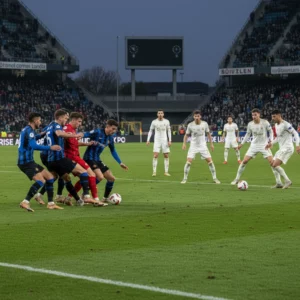

Why reading off-the-ball movement gives you an edge when finding value bets
You already know that the ball carrier often gets the headlines, but off-the-ball movement frequently determines who scores, who concedes, and which markets misprice a matchup. By training your eye and analytics to recognize purposeful runs, space creation, and defensive reactions, you can anticipate outcomes that betting markets might not fully account for. That anticipation is where value betting arises: when your expectation of an event’s probability differs from the bookmaker’s odds.
This guide teaches you to spot patterns that affect expected goals (xG), buildup quality, and transitional moments—then translate those insights into profitable wagering decisions. You’ll learn practical observational techniques, the most informative tracking and event data fields, and how those inputs feed simple predictive models or heuristics you can use pre-match and in-play.
How off-the-ball behavior changes match probabilities
Off-the-ball actions alter the supply and demand of space and time. A well-timed run behind a high line increases the chance of a successful through ball; a decoy run drags a central defender out of position and improves a teammate’s shot angle. You should think of movement as a probabilistic modifier: it raises or lowers the baseline chance a given sequence results in a shot on target, a high-quality chance, or a goal.
- Creating space: movement that enlarges a teammate’s operating area and increases shot quality.
- Disruption: movement that forces defensive reshaping and creates numerical imbalances.
- Support and recycling: movement that improves possession retention and chance creation over multiple phases.
Core concepts, data sources, and simple metrics to start analyzing movement
Before you build models or place bets, establish a baseline vocabulary and data toolkit. You don’t need enterprise resources to gain an edge—film study, accessible event feeds, and a few computed metrics are often enough to identify mispriced lines.
Movement types to track and why they matter
- Depth runs (runs in behind): increase the xG of through balls and counterattacks.
- Third-man runs: enable quick one-two sequences that bypass midfield pressure.
- Decoy runs: reduce defensive concentration on the intended shooter or passer.
- Offensive rotations: positional swaps that create overloads or isolations.
Practical data sources and beginner-friendly metrics
Use publicly available event data (passes, shots, locations) and free or affordable tracking clips to compute or observe these metrics:
- xG and shot location densities — to detect increased chance quality following specific movements.
- Pass-and-move sequences per 90 — to quantify an attacker’s activity off the ball.
- Expected possession value (EPV) shifts — to see how a run changes the value of a possession.
- Run frequency into final third or penalty area — correlates with scoring opportunities for forwards.
With these building blocks you’ll be able to translate visible and measurable movement into probabilistic judgments—next, you’ll learn how to combine these signals into simple models and betting rules that identify true value in markets.

Combining movement signals into simple predictive heuristics
Turn the raw signals you already track into rules-of-thumb you can apply quickly before placing a bet. You don’t need a full machine-learning pipeline to gain an edge—start with a handful of complementary indicators and treat them as probabilistic modifiers to the bookmaker’s implied odds.
Useful heuristic framework
– Baseline probability: convert the market odds to an implied probability. This is your starting point.
– Movement modifiers: apply additive or multiplicative adjustments based on observed movement metrics that materially affect chance quality. Examples:
– EPV uplift: if a team’s sequences that include a forward depth run produce an average EPV increase of +0.04 to +0.08 compared with possessions without the run, increase that team’s goal expectancy accordingly.
– Run density into penalty area: a forward with >2.0 runs into the box per 90 and a high on-target shot ratio should raise the probability of the team scoring next or winning by a small but meaningful margin.
– Pass-and-move frequency: if a side completes >12 pass-and-move sequences per 90 against teams that struggle to press, increase expectation for sustained possession and chances.
– Defensive counterweights: always subtract for opposing defensive behaviors—high recovery interceptions, compactness metrics, or a dominant aerial presence that neutralizes depth runs.
Simple betting rules you can start with
– Pre-match: back Team A to score over 1.5 goals when Team A’s expected goals from final-third runs is at least 15% higher than Team B’s conceded xG from runs, and Team A’s key forward averages >1 run into the box per 90. These conditions indicate a persistent ability to create high-quality looks that markets often underweight.
– Match result: favor the underdog in draw-heavy fixtures if their counterattacking run frequency and EPV on turnovers are both in the top quartile—bookmakers often underprice sudden counter risks.
– Player props: back a forward for “shots on target” when their personal run-to-shot conversion (shots produced per run into the box) is meaningfully above league average and the opponent concedes a high share of such runs.
Risk management and validation
Require at least two independent signals before placing a stake, track outcomes in a simple spreadsheet, and estimate your realized edge. Aim for wagers where your adjusted probability exceeds the market-implied probability by a clear margin (commonly >5% for a conservative edge).
In-play reading: short-term edges from live movement patterns
The biggest opportunities often appear in-play when movement patterns reveal momentum shifts that markets react to slowly.
Key live cues to watch
– Early defensive reshaping after substitutions: a substitute fullback who delays recovery runs can create exploitable space for depth runs in the next 5–10 minutes.
– Repeated decoy runs without reward: if a team’s decoy movement consistently drags defenders out but the delivering pass is mis-timed, the next correctly timed pass often produces a higher xG—consider next-goal or immediate shot markets.
– Press fatigue: after a period of intense pressing, attacking teams that maintain high run frequency while defenders’ recovery sprints drop (visible as slower repositioning) gain a short window of higher chance quality.
In-play betting rules
– Next-goal: target the side making successful depth runs into space behind a tiring defense within five minutes of a high-intensity sequence, provided the team’s conversion-of-chances metric is reasonable.
– Over/Under: shift toward over when both teams increase third-man runs and pass-and-move sequences in the final 20 minutes—these patterns produce recycled chances that inflate xG quickly.
– Live hedging: use small, quick hedges when the opponent adjusts coverage (e.g., a centre-back steps out more often), which often reduces the initial attacking team’s edge.
Execution tips
Watch the game with a clear checklist of signals, be ready to act quickly, and size stakes conservatively for in-play volatility. Live edges are shorter and smaller—confirm movement evidence before committing.

Putting edges into disciplined practice
Turning observational skill into consistent profit requires a routine: test small, record everything, and iterate. Treat each identified movement edge as a hypothesis—log the conditions, stake size, outcome, and what you learned. Over time you’ll filter out false positives, calibrate your modifiers, and sharpen sizing rules so that edges you once spotted casually become repeatable advantages. For additional reading on structured data sources and how professional analysts approach tracking, explore StatsBomb.
Keep your process simple, focus on a few high-signal indicators, and respect variance—consistent application and honest validation beat clever one-off calls.
Frequently Asked Questions
How can I evaluate off-the-ball movement without access to high-resolution tracking data?
Start with event footage and publicly available event feeds. Use video to time runs, observe spatial relationships, and count qualitative indicators (runs into the box, decoy movements, rotations). Combine these observations with event-derived metrics like pass sequence locations, xG changes after specific move types, and simple per-90 rates. Even without tracking, a disciplined film routine plus basic event stats yields useful signals.
What staking strategy is recommended when placing bets based on movement heuristics?
Begin with small, fixed-percentage stakes of your bankroll (e.g., 1–2%) while you validate your model. Only increase sizing after demonstrating a positive edge across a meaningful sample. Use unit sizing tied to confidence tiers—smaller units for single-signal bets, larger for multi-signal confirmations—and always enforce stop-loss limits to protect against streaks of variance.
Which defensive metrics should I monitor to avoid overvaluing attacking runs?
Watch opponent compactness (how narrow they remain under pressure), recovery interception rates, aerial duel win share, and their propensity to allow clearance-prone sequences. High interception/clearance rates and sustained compactness reduce the effectiveness of depth and third-man runs. Always offset attacking signals with at least one defensive counter-signal before sizing up a wager.