

How off-the-ball movement alters what xG models see — and what they miss
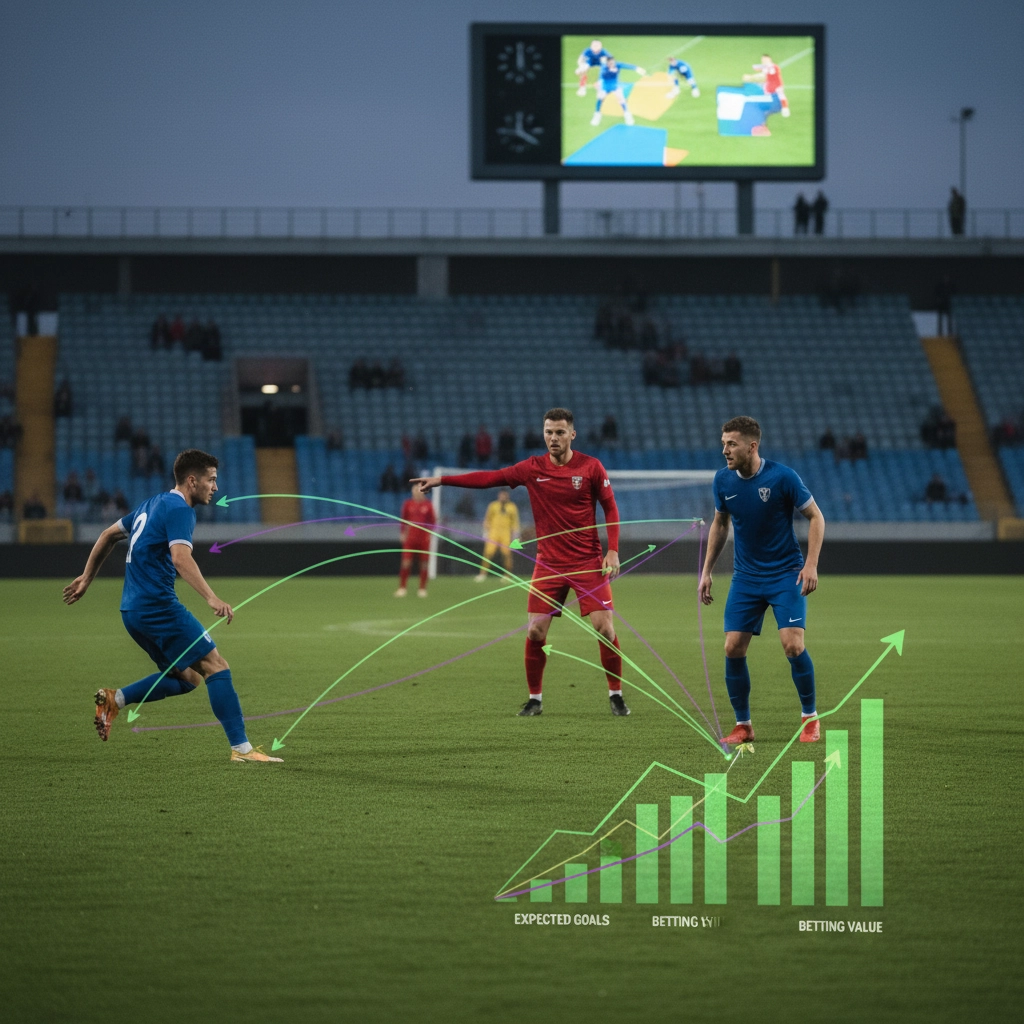
You already know that expected goals (xG) estimates the probability a shot will result in a goal based on shot location and certain situational features. What you may not appreciate is how many critical influences happen away from the ball: decoy runs, spatial manipulation, screening defenders, and coordinated pressing all change the quality of chances without being obvious in basic shot-level data. When you evaluate xG as a bettor, you need to see it as a baseline probability that can be meaningfully shifted by off-the-ball roles.
Why tracking context matters for bettors
Traditional xG models use features like shot distance, angle, assist type, and whether the shot was a header. Those are valuable, but they omit context you can often observe visually or in tracking feeds:
- Space created by teammates: A run that drags a centre-back wide increases the effective shooting angle even if the final pass was ‘simple’.
- Distraction and screening: A teammate standing between a goalkeeper and shooter changes goalkeeper reaction time and sightlines.
- Pre-shot build-up: Short, patient passing sequences and off-the-ball movement can unsettle defensive structure and lead to higher-quality finishing positions than raw coordinates imply.
- Rebound positioning: Players positioned for second balls increase conversion chances after an initial save.
As a bettor, you should treat raw xG as the starting point. When you can identify consistent tactical patterns — for example, a striker whose movement routinely pulls defenders out of the box — you can mentally adjust xG upward for those scenarios or seek markets where the public relies on crude numbers.
Which off-the-ball roles you can track quickly and how they affect betting value
Not every off-the-ball nuance requires expensive tracking data. You can prioritize a handful of observable roles that commonly change shot quality and therefore betting value:
- Decoy runs and channel occupation: When a player occupies central defenders’ attention, the shooter often gets a clearer shot/angle. This raises the real conversion chance above model xG.
- Overload creators: Wide players who pull an extra defender out of the box create numerical advantages — more time and better finishing positions.
- Pressing and counter-press: Teams that win the ball high force quick, high-quality chances; even if xG per shot is modest, the volume of good opportunities increases.
- Set-piece positioning and second-ball specialists: Players who habitually win second chances or attack the near post improve the effective xG after a set-piece starts.
When you watch games or review clips, annotate recurring off-the-ball actions and compare them to model outputs in live markets. Markets that rely on basic xG often underprice teams or players whose off-the-ball influence isn’t reflected in shot coordinates, creating betting value for you to exploit.
Next, you’ll learn how to quantify these effects using available tracking data and simple adjustments you can apply to xG when placing bets.
How to measure off-the-ball influence without premium tracking feeds
If you don’t have access to Second Spectrum or bespoke tracking APIs, you can still build a robust signal by combining public event data with quick video coding. Start with these accessible inputs and reproducible steps:
– Public event metrics to pull: xG per shot, xGChain/xGBuildup (StatsBomb/FBref), passes into the box, progressive passes, and shots following turnovers. These give a baseline of how often a team’s pattern produces chances.
– Visual coding checklist (fast and repeatable): for a sample of 10–20 attacks, tag whether there was a decoy run, an overload that pulled a defender out of the shot corridor, a screen in front of the keeper, or a set-piece second-ball header. Log the minute, shot xG, and final outcome.
– Simple derived ratios: percent of shots preceded by a decoy run, percent of shots with ≥3 attackers in the box, or average time from pass to shot. These are your proxies for spatial manipulation, numerical advantage, and pressure-cooker scenarios.
– Quick quantitative rules: if >30% of a team’s sampled shots involve successful decoy runs, flag their shots as “enhanced.” If average pass-to-shot time is under 3 seconds and xGChain is high, flag for high-press conversion.
These elements let you translate what you see into repeatable signals. Keep samples small but focused (last 3–5 matches, or the specific opponent matchup you’re betting) so your observations remain timely.
Practical xG adjustments and where they give the biggest market edge
Turn your observations into concrete adjustments you can apply pre-match and in-play. Use conservative, testable tweaks rather than wild guesses:
– Per-shot adjustments: add a small absolute uplift for clear spatial gains — think +0.02 to +0.05 xG for a shot where a decoy run meaningfully widened the angle, and +0.01–+0.03 for a screened goalkeeper or second-ball positioning. For shots created inside a sustained overload, consider a +10–25% relative increase.
– Volume adjustments: for teams that consistently win the ball high and create quick chances, increase expected shot volume rather than per-shot value. If a team’s shot rate per possession is 20–30% above league average, model them as likely to exceed simple xG forecasts even if average xG/shot is unchanged.
– Market application:
– Match totals and team goals: apply combined per-shot and volume adjustments to expected team goals. Small per-shot uplifts compound rapidly when the team takes many shots.
– Anytime scorer and prop bets: for players who frequently occupy second-ball zones or attack near-posts, boost their conversion probability by the same per-shot uplift; these markets are often underreactive.
– In-play value: when you see a sequence of pressing turnovers leading to low-shot-delay chances, favour over markets or quick scorers rather than relying on the static model xG.
Always validate your rules with a small bank and tracking sheet. Record your pre-bet adjustment, market chosen, and outcome over 50–100 bets; this prevents hindsight bias and helps you refine how much to nudge xG in different tactical contexts.

Putting it to work on your ticketing strategy
Take a structured, conservative approach: translate what you observe into small, repeatable adjustments; log each bet and the rationale; and iterate based on outcomes. Treat off-the-ball signals as tilt factors you add to baseline xG rather than wholesale replacements for models. Over time, disciplined testing will reveal which tactical cues — decoy runs, overloads, high press sequences, set-piece positioning — reliably move outcomes in ways the market underestimates.
Target markets where those small edges compound: match totals and team goals (where per-shot uplifts add up), anytime-scorer and second-ball props (where positioning matters most), and live in-play markets that react slowly to sustained tactical dominance. For practical reading on how event- and tracking-based analytics inform these choices, see advanced analytics resources.
Finally, respect variance. Even sound tactical adjustments will lose frequently; the goal is a positive expected value over many bets. Keep stakes proportional to your edge, refine your coding rules, and remain skeptical of one-off results. That discipline—not perfect prediction—creates lasting betting value.
Frequently Asked Questions
How much should I adjust xG for decoy runs or screens?
Use small, testable nudges. A typical rule is an absolute uplift of about +0.02 to +0.05 xG for clear decoy runs that widen the angle, and +0.01–+0.03 for goalkeeper screening or second-ball setup. Apply these conservatively, record results, and tighten or loosen the range based on your sample of 50–100 bets.
Can I find profitable edges without access to premium tracking data?
Yes. Combine public event metrics (xG, xGChain/xGBuildup, passes into the box) with quick visual coding of 10–20 attacks to capture decoy runs, overloads, and screens. Those proxies are often enough to exploit markets where the public relies on basic xG outputs.
Which betting markets are most sensitive to off-the-ball influence?
Match totals and team goals (because per-shot uplifts compound), anytime-scorer and second-ball props (player positioning matters), and in-play markets driven by sequences of high press or quick turnovers. Set-piece props also respond well to repeatable second-ball and near-post specialists.