Why leadership sets the tone for your team’s performance
When you lead a football team—whether as a coach or a captain—you shape more than tactics and fitness. Your leadership determines how players respond under pressure, recover from setbacks, and adopt a collective identity. Effective leadership reduces confusion on match day, raises standards in training, and turns individual talent into coordinated performance. This section explains the role you play and the core principles that create a stable, high-performing environment.
Core leadership principles every coach and captain should share
- Clarity of purpose — Define short-term goals (match plans, training focuses) and long-term goals (season targets, player development) so everyone knows what success looks like.
- Consistent communication — Use simple, repeatable messages. Deliver information in multiple formats: briefings, whiteboard sketches, one-to-one chats, and written notes.
- Trust and accountability — Build trust through predictable behavior and hold players accountable with fair, transparent consequences and recognition.
- Emotional control — Model composure. When you manage emotions, you enable players to focus on decisions instead of panic or frustration.
Practical leadership habits for coaches
As a coach, your daily habits create the context where leadership flourishes. You design training, set expectations, and mentor captains. Adopt routines that make leadership visible and teachable.
Daily and weekly routines that reinforce culture
- Structured training plans — Start each session with clear objectives and end with a review that links work to team goals.
- Pre- and post-match scripts — Standardize how you brief and debrief so key messages are repeated and internalized.
- Leadership meetings — Hold a weekly check-in with the captain and leadership group to discuss behaviors, selection concerns, and player welfare.
- Visible standards — Use checklists or simple metrics (punctuality, effort, tactical discipline) so expectations are measurable.
How captains translate vision into on-field action
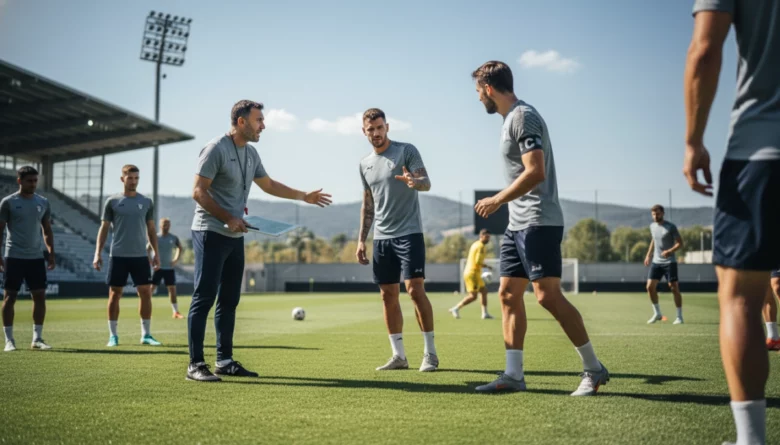
Captains are your extension on the pitch. They convert coaching directives into immediate decisions and interpersonal interventions. To be effective, ensure your captain understands tactical priorities and possesses the soft skills to lead teammates.
Captain behaviors that influence games
- Directive communication — Give short, timely instructions that influence positioning and shape during play.
- Conflict management — Calm disputes quickly and privately to avoid fracturing focus.
- Motivation and standards — Reward effort publicly and correct lapses discreetly to maintain morale and standards.
These foundational ideas—shared principles, coach routines, and captain behaviors—prepare you to implement concrete tactics and training drills. Next, you will explore specific communication protocols, decision-making frameworks, and practice drills that embed leadership into every session and match.
Communication protocols that reduce noise and improve clarity
On the pitch, quantity of communication is less important than quality. Coaches and captains should agree on a small, shared vocabulary and delivery rules so messages cut through during high-intensity moments.
- Establish a shared micro-language — Limit core in-game commands to 6–8 short cues (examples: “Press,” “Cover,” “Drop,” “Switch,” “Go,” “Hold”). Teach exact meanings and expected actions so every player responds the same way.
- Use script templates for phases — Standardize what’s said at key moments:
- Pre-kickoff (captain): “Structure: compact, aggressive at 60’, reset if we concede.”
- Half-time (coach): “Priority one: stops on quick switches. Priority two: exploit left-hand channel from set pieces.”
- Late-game (captain): “Protect. Possess. Calm on 1v1s.”
- Delivery rules for on-field calls — Make calls punctual and directional:
- Start with a trigger word (e.g., “Now!”) if urgency is high.
- Follow with one-word action and location (e.g., “Press — right!”).
- Limit follow-ups to one corrective phrase; defer detailed coaching until stoppage.
- Non-verbal cues — Develop hand signals for common adjustments (shape, tempo, man-marking). These are invaluable when crowd noise makes speech unusable.
- Reinforcement loop — After matches and in training, review calls with video and ask: “Was the cue heard? Was the response correct?” Repeat and refine until the language is reflexive.
Decision-making frameworks for captains and coaches in pressure situations
Pressure compresses time and increases error. A shared decision framework replaces panic with process. Use simple, repeatable algorithms that both coach and captain understand.
- The A-D-E model (Assess — Decide — Execute) — Train leaders to:
- Assess: 3-second scan for score, time, personnel, space.
- Decide: choose from a pre-agreed option set (e.g., hold possession / counter / reorganize).
- Execute: relay one clear instruction and commit to it.
- Decision templates by scenario — Provide canned responses for common game states. Example:
- If leading and down to 10 minutes: prioritize possession, avoid risky dribbles, substitute a fresh midfielder at first natural stoppage.
- If trailing with 15 minutes: increase forward pressing intensity, allow full-backs to overlap, use a third substitution to add attacking width.
- Delegation map — Define which decisions the captain can make autonomously (organize defensive shape, manage tempo, make in-game substitutions suggestions) and which require coach input (major tactical shifts, formation changes). Clear boundaries reduce hesitation.
- Time windows and checkpoints — Use short checkpoints (5–10 minute reassessments) rather than continuous tweaking. This keeps decisions deliberate and measurable.
Practice drills that embed leadership into training
Leadership is a skill that improves with structured repetition. Design drills where the captain and emerging leaders have explicit responsibilities and measurable objectives.
- Small-sided “Captain’s Command” (6–8 minutes rounds) — The captain calls one tactical constraint for the round (“no through-balls,” “attack only left”). Reward teams that meet the constraint with extra points. Rotate the captain role to develop decision-making and communication under pressure.
- Pressure-scenario simulation — Create end-of-game simulations with time, score, and man-down scenarios. The captain must organize the team; coaches only intervene during stoppages. Debrief leadership choices with clips immediately after each rep.
- Silent training — Play short drills where verbal communication is banned; leaders must use gestures and eye contact. This sharpens non-verbal clarity and listening skills.
- Leadership scoring and feedback — Track metrics: clear communications per minute, successful conflict resolutions, organization speed after transition. Use a simple leadership scorecard to give focused feedback in leadership meetings.
- Video-led reflection — Record sessions and highlight 2–3 leadership moments each week. Use these clips in the leadership meeting to praise, correct, and set next steps.
Implementing changes: a simple step-by-step roadmap
- Pick one leadership habit to prioritise for the next two weeks (e.g., shared micro-language or weekly leadership meetings).
- Set a single measurable outcome tied to that habit (e.g., fewer in-game misunderstandings, faster organisation after transitions).
- Run focused drills and simulations that expose the team to the new habit under realistic pressure.
- Collect feedback via brief leadership check-ins and review short video clips to reinforce learning.
- Reflect, adapt, and then introduce the next habit—build change incrementally rather than all at once.
Lead for the long game
Leadership in football is not an event but a continuous practice. Small, consistent choices from both coach and captain create durable culture and clearer on-field decisions. Commit to experimentation, measure what matters, and treat setbacks as learning opportunities rather than failures. For further practical frameworks and coaching resources to support this work, see UEFA coaching resources.