Why off-the-ball movement is the midfielder’s most valuable asset
As a midfielder, how you move without the ball determines how often you receive it in dangerous positions, how effectively you link play, and how you create space for teammates. Off-the-ball movement consists of readable actions—runs, checks, and rotations—that can be practiced and refined to sharpen timing, awareness, and influence when not in possession.
Train with three measurable outcomes in mind: create space (for yourself or a teammate), offer passing options, and disrupt the opponent’s defensive shape. Movements that don’t achieve at least one of these outcomes waste energy and reduce team effectiveness.
Fundamental principles to teach and apply during off-the-ball sessions
Before running specific exercises, agree a simple framework so drills translate into match performance: every movement should have a purpose, an appropriate angle and tempo, clear cues, spatial awareness for rotations, and conditioning under decision load.
1. Purposeful runs
- Define the intent: Each run should stretch a defence, open a passing lane, or provide an outlet—players must know the “why.”
- Timing over distance: A short, perfectly timed burst often beats a long, early run; sync runs with the passer.
2. Angle and tempo
- Approach angles: Diagonal approaches open passing lines and shield you from markers.
- Vary speed: Use changes of pace to lose defenders—invite then explode.
3. Communication and visual cues
- Non-verbal: Eye contact, shoulder feints and body shape help teammates anticipate movement.
- Verbal: Short cues like “turn” or “fill” synchronise actions in high tempo play.
4. Spatial awareness and rotation
Be ready to rotate: if a run drags a defender, a teammate must occupy the vacated space. Small-group rotation drills make these exchanges instinctive.
5. Conditioning with cognitive load
Combine sprints with quick pattern recognition so movement choices remain sharp late in games. Practice decisions under physical stress to mirror match fatigue.
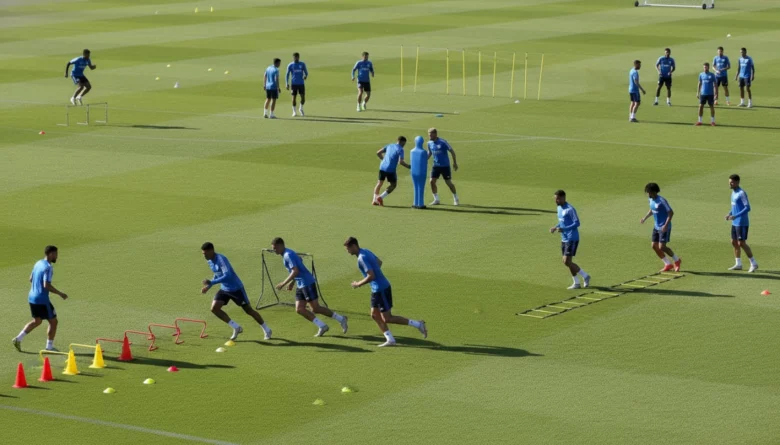
With these principles, drills teach context, timing and team interplay. Below are seven practical, progressive exercises to train these skills on the training ground and replicate match scenarios.
Third‑man overload: sharpening angled support and timing
Objective: Train midfielders to be the third option—moving at the right angle and moment to receive a penetrating pass or unlock a compact defence.
Setup
- Area: ~20 x 30 metres.
- Players: 7 attackers (2 neutrals) vs 4 defenders; aim to progress into an end zone or to a target behind the line.
- Duration: 5–6 minute rounds, 3–4 sets.
How it runs
Attackers circulate with quick touches. Midfielders occupy half‑spaces and make third‑man diagonal runs after a pass between two players to receive beyond defenders or drag them out of shape. Defenders counter by winning possession and attacking a small target.
Coaching points
- Intent: Ask players to state whether the run is to pull a marker, open a lane, or provide a safe outlet.
- Approach angle & timing: Use diagonal approaches; start the run as the passer prepares—use shoulder/head cues as triggers.
- Body shape: Show for forward passes when possible; protect the ball when pressured.
Progressions
- Introduce a deep neutral target and reward entries behind the line.
- Limit touches or increase defenders to force quicker decisions and sharper angles.
Rotational grids: practicing spatial swaps under pressure
Objective: Build instinctive rotation between central and wide midfielders so the team covers vacated space and maintains passing symmetry when a teammate penetrates or draws a marker.
Setup
- Area: 25 x 25 metres into three vertical lanes.
- Players: 6 attackers (2 per lane) vs 4 defenders; optionally one floater.
- Duration: 4–5 minutes per drill; rotate roles so everyone practices occupying and vacating.
How it runs
Play starts in one lane; midfielders rotate when a player dribbles into or receives pressure in the next lane. The vacating player must sprint into a new lane to offer an option while defenders exploit poor rotations.
Coaching points
- Awareness: Check shoulders to anticipate when a teammate’s action requires a shift.
- Speed of occupation: Replacement must arrive quickly—delays invite counters.
- Decision rules: Simple triggers: if ball turns wide, central fills; if central drives, wide tucks in.
Progressions
- Add end‑targets and award points for rotations that lead to shots or entries.
- Limit touches or increase defenders to speed rotations and decision-making.
Decoy runs and blind‑side entries: training the art of distraction
Objective: Use deliberate decoys so teammates can exploit the defender’s blind side with penetrating passes.
Setup
- Area: 30 x 20 metres with a small target zone or mini goal.
- Players: 6 attackers (one target) vs 4 defenders; rotate roles.
- Duration: 4–6 minute rounds; focus blocks of 2–3 runs per player.
How it runs
Midfield circulation continues while one player performs a decoy run to draw a marker. A teammate times a blind‑side run into the vacated space or receives a pass behind the defensive line to feed the target.
Coaching points
- Run quality: Make decoys believable with changes of pace and body language.
- Timing & weight: Blind‑side entries start as the decoy commits; passes must match defender momentum.
Progressions
- Add a goalkeeper/full goal to reward correct execution with a finish.
- Allow more aggressive defending or add an extra defender to force clearer decoys and sharper passes.
Late runs into the box: timing and finish
Objective: Practice arriving late from deep to create numerical advantages in the box and finish under realistic pressure.
Setup
- Area: Attacking third (penalty arc to just outside box), include wide channels.
- Players: 3 midfielders, 2 wingers, 2 strikers vs 4 defenders + goalkeeper.
- Duration: 6–8 minute bouts, swapping midfielders so each practices timing.
How it runs
Play begins wide or through midfield. Midfielders delay forward movement until the ball enters the final third, then sprint in for crosses, cutbacks, or through balls. Defenders mark tightly; attackers aim to finish or recycle quickly.
Coaching points
- Delay & burst: Stay patient on the edge, then use a short high‑intensity sprint to arrive late.
- Arrival angles: Choose near or far post runs based on service and defensive shape.
Progressions
- Reward successful late arrivals with points or by restarting in the attacking phase to encourage consistency.
- Increase physical demand with a brief conditioning set before each bout to mimic match fatigue.
Rondo with recovery and shadowing: decision making under turnover pressure
Objective: Combine quick possession with immediate recovery and shadowing so midfielders learn to re‑position intelligently when possession changes.
Setup
- Area: 15 x 15 metre grid with two 5‑metre channels and small gates.
- Players: 8 attackers in the grid vs 4 defenders; 2 floaters in channels.
- Duration: 4 minute rounds; rotate defenders and floaters often.
How it runs
Attackers maintain a fast rondo. When possession is lost or the ball goes to a channel, attackers immediately execute recovery runs to cover channels and shadow counters. The fastest transition team attempts to play through the opposite gate or back into the grid.
Coaching points
- Urgency: Treat every turnover as a transition—recovery runs must be immediate and purposeful.
- Covering angles: Recover into positions that block obvious counterlines, not just chase the ball.
Progressions
- Limit touches in the grid to force quicker decisions and sharper recovery work.
- Add a requirement to make a set number of passes after a turnover before attempting the gate to emphasise consolidation.
Putting training into match practice
Train these exercises in a progressive cycle: introduce the concept, drill at low speed, add pressure and decision‑making, then place it into conditioned or full‑sided play. Keep coaching cues simple—purpose, timing, and angle—and measure success by the outcomes defined at the start of each drill (space created, successful entries, or prevented counters). Rotate roles so every midfielder practices decoying, arriving late, rotating, and recovering. Over time these movements should become instinctive, adaptable, and directly translatable to match moments.
For additional session plans and coach education resources, see The FA Coaching Hub.