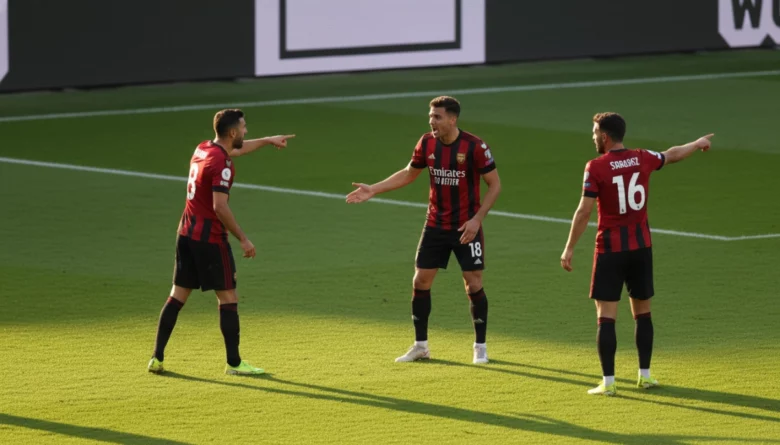
How off-the-ball communication shapes possession and attacking tempo
You spend a lot of time watching what happens on the ball, but matches are often decided by what you and your teammates do away from it. Off-the-ball communication — the combination of talk, signals and spatial awareness — helps you create space, maintain shape and trigger coordinated movements. When you learn to read situations and express clear, consistent cues, you become an active organizer even without the ball.
Think of communication off the ball as three linked capacities: the words you say, the gestures or signals you use, and the way you position yourself in relation to teammates and opponents. Each element reinforces the others: a short call backed by a decisive run or hand signal removes doubt and speeds decision-making for the player on the ball.
Short verbal cues: what to say and when
Verbal communication off the ball must be brief, audible and purposeful. You won’t help the team by shouting long explanations; instead, focus on a small vocabulary of clear cues, practiced so that every teammate understands them instantly.
- Directional cues: “Far”, “inside”, “over” — tell the ball carrier where to play or which angle to exploit.
- Movement prompts: “Turn”, “check”, “go” — ask a teammate to change their run or feint to create space.
- Alert words: “Keeper”, “on”, “switch” — warn about presses, overlaps, or an open channel on the opposite side.
- Role reminders: “Hold”, “press”, “stay” — keep shape intact during transitions and set pieces.
Practice makes these cues efficient: rehearse them in training so they are crisp and delivered at the right volume. As you develop a common language with teammates, calls become predictive tools — a single shout can initiate a coordinated sequence of runs and passes.
Signals and body language to speed up the game
When noise is high or opponents are close, non-verbal signals reduce confusion. A raised hand, a pointed thumb or a subtle body angle can confirm a planned movement without tipping off the opposition. You should adopt a few agreed gestures for high-frequency situations, like indicating a through ball lane or requesting the ball into feet.
- Use open palms or a visible index to show where you want the ball.
- Lock eye contact briefly after signaling to confirm understanding.
- Employ consistent pre-play gestures during set pieces to mask tactical variety while keeping teammates informed.
Clear signals let the ball carrier anticipate options and free up time on the ball — the combined effect of talk and sign rapidly increases team fluidity. Next, you’ll look at how spatial awareness ties talk and signals together, with specific positioning principles and drills to drill these habits into match play.
Spatial templates: positioning principles for off-the-ball influence
Spatial awareness is the connective tissue between talk and signals. It’s not enough to call or point — you must occupy or create the right pockets so those cues become useful. Think in templates rather than fixed spots: width, depth and half-space each have roles depending on game state.
- Width: Stretch the play by occupying wide channels when you want to open central lanes. A winger hugging the touchline drags a full-back out; a slightly narrower position invites the overlap and creates a clearer passing angle.
- Depth: Vary your depth to manipulate defensive lines. A deeper support option gives the ball carrier a safe outlet; an advanced check-in draws markers forward and frees space behind for midfielders to exploit.
- Half-space: The corridor between wide and central zones is prime for off-the-ball influence. By occupying half-spaces you create triangular passing structures that simplify decision-making for the ball carrier and produce 2v1s against full-backs.
Use these templates as flexible guides: if the opposing team pushes high, shorten distances; if they sit deep, increase lateral separation to generate diagonal passing lanes. Small positional adjustments — a meter wider, half a step deeper — significantly change passing angle and sightlines, and when combined with a short call or a raised hand they remove hesitation from the ball carrier.
Drills to ingrain talk, signals and spatial habits
Training must replicate the sensory load of matches so players learn to communicate under pressure. Below are practical drills that force verbal clarity, consistent signals and disciplined positioning.
- Directional rondo (6v2): Play with two neutral targets on opposite sides. Require a vocalised cue before a switch (e.g., “switch” + point). Progress: silent rounds where only a gesture is allowed.
- Pattern play with triggers: Set a sequence where a third-man run is only initiated after a two-word call. This ties timing to communication and teaches players to delay or accelerate runs based on the carrier’s needs.
- Shell-shape possession: Defensive players shadow movement while attackers must keep defined widths and depths. Coach rewards off-the-ball prompts that lead to clean exits from pressure.
- Pressure-and-release scenarios: Create variants where the ball carrier is pressed aggressively; teammates must use a pre-defined gesture to request the ball into feet or on the half-turn, reinforcing non-verbal clarity under noise.
Keep drills short and repetitive. Use constraints (limited touches, mandatory vocal cues) so communication becomes automatic and spatial habits form as muscle memory rather than abstract instruction.
Timing and anticipation: reading the moment without the ball
Great off-the-ball work is anticipatory — it predicts what will become available rather than reacts to what already is. Anticipation comes from scanning, reading body orientation of teammates and opponents, and using small pre-movements to test reactions.
- Scan early and often: a quick shoulder check before a teammate receives allows you to time a run to the exact moment space opens.
- Use probing steps: a half-step towards a channel can draw a defender or reveal an opening; communicate this probe with a short call so the ball carrier knows it’s intentional.
- Match tempo to trigger points: speed up your run when a defender turns or slows when a teammate faces pressure, using a simple cue (“now”, “hold”) to synchronise timing.
When players learn to anticipate together, off-the-ball communication becomes predictive rather than corrective — and that is the difference between possession that meanders and possession that creates consistent danger.
Next steps for teams and coaches
Make communication off the ball a regular, measurable part of your routine rather than an occasional reminder. Set small, specific targets each week (one gesture to master, one vocal cue to enforce, one positional template to rehearse) and review them openly at training and in video sessions. Use controlled small-sided games to test changes under pressure and track whether cues reduce hesitation and improve decision speed over time. For practical session ideas and wider training frameworks, consult UEFA coaching resources.
Simple match-day rules to reinforce habits
- Limit verbal calls to a shared four-word vocabulary so signals stay crisp and recognisable.
- Agree on two non-verbal gestures (one for “ball into feet”, one for “through run”) and insist on their use in noisy situations.
- Assign a scanning rhythm—every 5–7 seconds—for players in key support roles to improve anticipation.
- Debrief one communication success and one failure after every match to create a learning loop.
Adopting these small, repeatable rules builds a culture where talk, signals and spatial choices become instinctive. Over time that culture—not individual brilliance—will be what consistently turns possession into purposeful progress and opens reliable attacking channels.