Why off-the-ball play is essential for the modern player
You already know that goals and assists get headlines, but professional teams prize the players who create space, press intelligently, and open passing lanes when they’re not touching the ball. Off-the-ball play is the unseen engine of team performance: it influences tempo, creates overloads, and disrupts opposition shape. If you want to move from youth football to the professional ranks, developing your off-the-ball intelligence is not optional — it’s foundational.
Early development should focus on helping you read situations, anticipate movement, and execute purposeful runs and positioning. Clubs and coaches assess these traits as much as they measure speed and technique, because consistent off-the-ball competence differentiates late developers and attracts scouts who look beyond isolated moments of brilliance.
How grassroots to academy pathways shape off-the-ball abilities
Play-first foundations (ages 6–12)
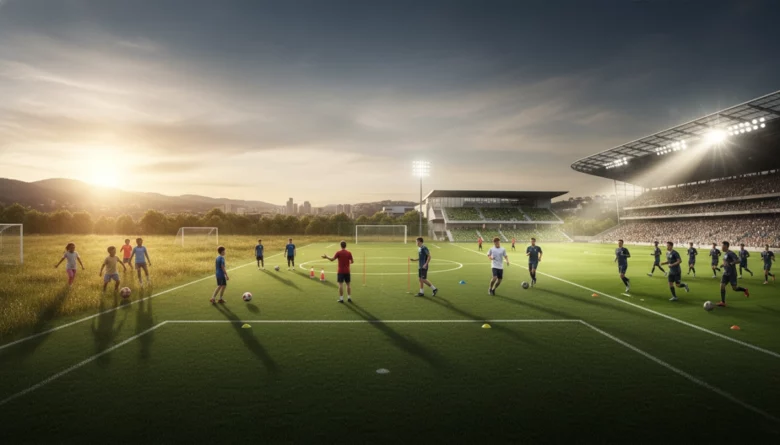
At the grassroots stage you should prioritize exploration and diverse playing experiences. Small-sided games, mixed positions, and informal play help you internalize spatial relationships without heavy tactical prescriptions. Coaches should encourage you to try different roles so you learn how defenders, midfielders, and forwards move relative to one another.
- Emphasize movement patterns over rigid positions: teach diagonal, lateral, and depth runs through games rather than drills with fixed starting points.
- Use varied game formats (3v3, 4v4, 5v5) to increase touches and decision variety — this accelerates pattern recognition for off-the-ball actions.
- Keep coaching feedback simple and frequent: cues like “check shoulder,” “create depth,” or “pin the full-back” are actionable for young players.
Skill consolidation and cognitive development (ages 13–16)
As you enter adolescence, you must convert playful habit into deliberate practice. At this stage, coaching focuses on scenario-based training that replicates match constraints and forces quicker decisions off the ball. You’ll start learning team shapes, pressing triggers, and how your movements combine with teammates’ runs to manipulate space.
- Introduce video review of training and matches so you can see patterns you might miss in real time — this reinforces learning and fosters self-analysis.
- Practice transitional moments: how your positioning changes when possession is won or lost, and how immediate off-the-ball choices create counterattacking or defensive stability.
- Balance technical touches with conditioned games that target specific off-the-ball behaviours (e.g., overload creation, third-man runs, or isolating a defender).
While you progress through these early stages, physical maturation and individualized load management become increasingly important — you must move safely and sustainably as training intensity rises. In the next section you’ll find focused drills, tactical frameworks, and coach-led practices that translate these early foundations into professional-level off-the-ball competence.
Coach-led training: structuring sessions for measurable off-the-ball gains
Coaches bridge the gap between intuition and repeatable performance. Structure sessions around clear, observable outcomes rather than vague notions of “movement.” Each session should target one or two off-the-ball behaviours, use progressive constraints, and finish with a match-like phase where those behaviours must be executed under realistic pressure.
- Session design template: warm-up (10–15 min) with dynamic movement patterns and perception drills; focused drill block (20–25 min) with progressive constraints; small-sided conditioned game (20 min) that replicates the tactical aim; cool-down and video review (10 min).
- Use constraints to force decisions: limit touches to encourage timing of runs; designate zones where off-the-ball players must receive in (end-zones) to teach depth; add bonus points for successful decoy and third-man actions to reinforce desirable outcomes.
- Coaching cues and feedback: deploy short, specific cues (“move to create depth,” “check away then sprint in,” “block passing lane”) and follow them with immediate, focused corrective feedback. Use stop–start coaching sparingly — only when correcting a systemic error — and favor in-play nudges to preserve decision rhythm.
- Progressive overload: increase decision complexity across the week. Start with static pattern drills, progress to constrained scrimmages, and end with full 11v11 or scenario-based reps where fatigue and opposition unpredictability test learned behaviours.
Essential drills and progressions for off-the-ball mastery
Translate principles into practice with drills that emphasize perception, timing, and purposeful movement. Below are high-impact exercises and logical progressions that carry through from academy to pro environments.
- Perception rondo (4v2 with release): Two defenders press while neutral players rotate; attackers must execute one-touch passes and off-the-ball rotations to free a target player. Progress to time-limited possessions and the inclusion of a target end-zone to reward penetrating runs.
- Third-man combination drill (7v5 in corridors): Create narrow channels where combinations and third-man runs are required to penetrate. Start with rehearsed patterns, then remove prescriptive cues and add passive defenders to force recognition and improvisation.
- Decoy-run sequencing (3v3 + 2 floaters): Focus on a trigger — where a forward’s run drags a centre-back, opening space for an overlapping midfielder. Vary which player initiates the decoy and include 2v2 finishing to link off-the-ball movement to goal outcomes.
- Pressing trigger practice (5v5 with target defenders): Teach triggers (bad body shape, back pass, poor first touch). Attackers practice coordinated pressing and cutting passing lanes; defenders practice recovery positioning. Progress from coached triggers to in-game conditional triggers.
- Pattern play to match transition (11v11 micro-sessions): Run short-phase matches that concentrate on a single channel (flank overloads, half-space rotations). Immediately follow a successful phase with a transition exercise to train positioning changes when possession flips.
Monitoring, feedback and individualized development plans
Development becomes professional when it’s evidence-driven. Use a mix of low-tech and high-tech monitoring to create actionable individual plans focused on off-the-ball growth.
- Qualitative tools: structured video tagging of runs, heatmap reviews, and coach–player walkthroughs. Ask players to self-identify one off-the-ball habit each week to correct.
- Quantitative indicators: distance between lines, number of effective decoy runs per 90, pressing success rate, and entries into high-value zones. GPS and event data help, but simple counts from match clips are effective at youth level.
- Individual development plans (IDPs): set 4–6 week targets (e.g., increase successful third-man entries by 30%, reduce offside occurrences from mistimed runs). Align physical load, technical reps, and tactical video sessions to those targets and reassess regularly.
Moving forward: applying off-the-ball principles
Development doesn’t stop at a checklist — it’s a continual cycle of practice, feedback and adaptation. Players, coaches and clubs must commit to creating environments where off-the-ball behaviours are practiced under realistic constraints, measured, and reinforced through clear, short-term goals and steady long-term habits.
Immediate priorities for players
- Pick one off-the-ball habit to improve each week (timing of runs, pressing triggers, spatial awareness) and work it into training and matches.
- Use video to review your decisions: tag three runs per match and note one adjustment to try next time.
- Train in different positions and formats to broaden spatial understanding and adaptability.
- Manage load and recovery so cognitive sharpness for decision-making is preserved during intense phases.
What coaches and clubs should commit to
- Design sessions that isolate then reintegrate specific off-the-ball behaviours, with measurable outcomes and progressive constraints.
- Integrate simple monitoring (video tagging, counts of effective runs) into IDPs and reassess every 4–6 weeks.
- Create communication channels for immediate, focused feedback — short cues during play and structured review afterward.
- Prioritize player decision variety across weekly microcycles to avoid over-prescription and encourage creative problem-solving.
Long-term mindset
- Value patience and repetition — intelligent off-the-ball play compounds over seasons, not days.
- Cultivate curiosity: study teammates’ tendencies, opposition shapes and subtle cues that trigger movement.
- Be adaptable: roles and systems change; your ability to read and react off the ball is what sustains a career.
For practical session plans, drills and coach-led progressions you can implement immediately, consult external coaching resources such as UEFA Training Ground for additional examples and inspiration.