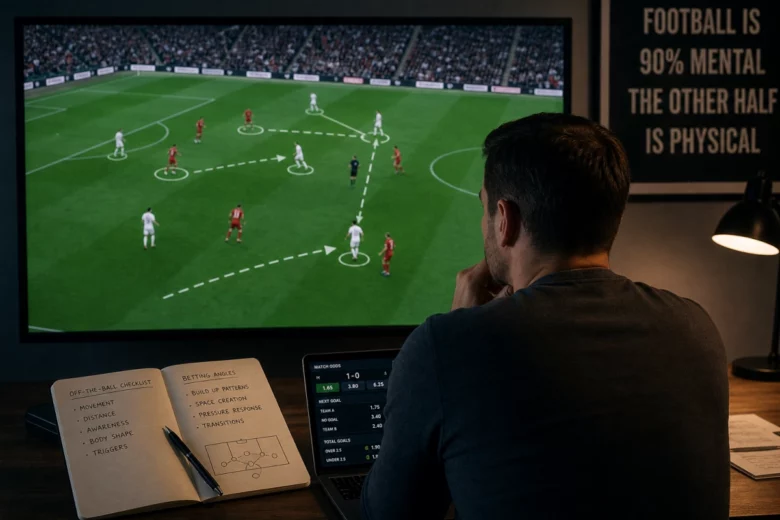
How football Off-the-Ball Players shape chances — and why bettors should care
Defining football Off-the-Ball Players and their importance to match flow
“Football Off-the-Ball Players” refers to those whose main contribution is movement and positioning when not in possession: strikers timing runs, midfielders drifting between lines, full-backs overlapping and centre-backs stepping into midfield. These movements change where chances originate and who benefits from them — affecting goal volume, timing and player prop outcomes. Bettors who recognise these patterns can better assess markets tied to chance frequency and goal distribution.
How movement and positioning alter match dynamics
Common off-the-ball patterns and their in-game effects
- Decoy/backward runs: Pull defenders out of line to create space for teammates and through balls.
- Overlaps/underlaps: Wide players and full-backs create overloads that increase crosses and cut-backs into danger areas.
- Interchange between lines: Midfielders dropping or wingers cutting inside open pockets for shots and key passes.
- High press and transitions: Coordinated forward movement forces mistakes; turnovers lead to high-quality transition chances.
- Late runs into the box: Timing alters aerial and rebound opportunities, shifting expected goals (xG) toward certain players.
These behaviors change shot locations, chance types (crosses, through balls, cut-backs) and which players appear in key statistics — all directly relevant to markets like over/under goals, BTTS and player props.
Early metrics and visual cues to monitor before and during a match
Combine season metrics with live visual signals for stronger reads. Below are compact indicators that reliably reflect off-the-ball influence.
Useful metrics and what they indicate
- Average position / heatmaps: Show where attackers and full-backs operate and whether they’re creating width or drifting inside.
- Passes received in final third & touches in box: Highlight players getting into danger areas.
- Player xG/xA maps: Reveal who repeatedly occupies high-value zones for goals or chances.
- Pressing stats (PPDA, pressures): High, effective pressing plus forward runs often presage quick transition goals.
Visual on-pitch signals to watch live
- Persistent decoy runs that drag defenders sideways — signals space for through balls or clear chances.
- Full-backs consistently high — raises cross/cut-back frequency and may increase total shots.
- Midfield compacting vs spreading — affects shot locations and BTTS likelihood.
- Striker timing late runs against a slow defensive line — strong sign for successful entries behind the defence.
Markets most sensitive to these cues include over/under goals, BTTS, handicaps and player props (shots, assists, goals). Use pre-match metrics to set expectations and live confirmation to adjust in-play.
Applying off-the-ball reads to market selection
Translate the cues into market choices by matching patterns to the markets they affect most. Below are concise pairings and decision rules to test and refine.
- Over/Under goals: High full-backs and wide overloads point toward Over 2.5; compact low blocks point toward Under 2.5 or Under 1.5 when combined with conservative chance creation.
- BTTS: Midfield spreading, diagonal switches and vulnerabilities from full-backs or centre-backs stepping into midfield raise BTTS probability.
- Handicaps/Asian lines: If a favourite’s wide play consistently creates clear chances, Asian -0.5/-1.0 may offer value. If the underdog sits deep but threatens on late entries, Asian +0.5 can be appealing.
- Player props: Back forwards making late box entries or midfielders consistently receiving between the lines for goals/assists or shots-on-target props.
- Timing markets: High press and transition patterns early suggest markets like “first 15/20-minute goal” or early BTTS opportunities in-play.
Staking, timing and practical limits to reliance on off-the-ball reads
Off-the-ball observation is useful but noisy and context-dependent. Convert reads into sustainable bets with disciplined staking and confirmatory thresholds.
Staking and timing rules
- Pre-match: baseline small stakes (e.g., ~1% of bankroll) for bets mainly from season metrics; raise stakes only with strong lineup/news confirmation.
- In-play: increase stakes incrementally (to ~2–3%) when live cues consistently confirm your read — repeated overlaps, high full-backs after 15–20 minutes, or a striker repeatedly getting behind the defence.
- Hedging: if match events threaten your pre-match position but off-the-ball cues still favour your read, hedge partially to lock profit or limit losses.
Limitations and risk management
- Small samples and randomness: one match’s patterns can be anomalous — combine live reads with season data.
- External changes: weather, injuries, refereeing and substitutions can quickly nullify an edge; reassess continuously.
- Bankroll discipline: avoid risking large portions of bankroll in-play; a typical cap is 2–3% on an in-play escalation.
- Responsible gambling: bet only with disposable funds, set limits, and avoid chasing losses.
Use live confirmation to guide stakes and always apply stop-loss rules. Treat off-the-ball reads as one input in a disciplined process.
Worked examples and short case studies
Case study 1 — Pre-match profile: high full-backs and wide overloads
Scenario: Team A shows inverted wingers and high full-backs; Team B defends narrow.
- Confirm: overlaps in the first 20 minutes, increased crosses and wide touches in the box.
- Decision: consider Over 2.5 (or Over 1.5 if odds are better) and shots props for wide attackers; BTTS only if Team B counters actively.
- Staking: 1% pre-match; increase to 2–3% in-play if structural width persists. Hedge if the first goal undermines your angle but off-the-ball cues still point to sustained chances.
Case study 2 — In-play read: late runs and a slow defensive line
Scenario: After 30 minutes, centre-backs are high and slow; an attacker times multiple runs behind them.
- Confirm: timestamps showing successful runs, growing touches in behind-the-defence areas, under-pressure clearances few.
- Decision: back the striker for a first-half or anytime goal; consider an Asian handicap for the attacking side.
- Staking: move to 2–3% after two successful runs; stop-loss if pacey defenders are introduced or frequent offside calls interrupt the pattern.
Case study 3 — Player prop: midfielder dropping between lines to create chances
Scenario: A midfielder’s heatmap and xA per 90 have increased; live footage shows him receiving between lines.
- Confirm: more passes received in the final third, key passes in build-up, higher xG-chain involvement.
- Decision: back assists or key-pass props; consider shots/attempts if he makes late box entries.
- Staking: small pre-match stake (1–2%); increase slightly in-play only if the role continues and opposition make no adjustments.
Putting reads into routine
Practice makes off-the-ball reading repeatable. Keep a simple log of observed cues, bets placed, stake sizes and outcomes. Over time you’ll identify which signals translate to profit and which are noise.
Create a short checklist for pre-match and fixed in-play intervals (e.g., 15 and 30 minutes). Pair live confirmation with disciplined stake sizing and stop-losses to prevent emotion-driven errors.
Finally, treat off-the-ball insight as one tool among many: combine it with sound bankroll management, attention to substitutions and events, and responsible gambling. Use small, tracked bets to refine patterns and let consistent evidence — not one-off results — shape your strategy.