Measuring leadership in football teams to inform betting decisions
How leadership traits affect match dynamics and market value
Leadership in football teams is one of the less obvious but influential match factors bettors can use to refine pre-match and in-play decisions. Captains, experienced on-field leaders, vocal communicators and a manager’s direction all shape how a team reacts to pressure, handles changing game states and executes tactical plans. When combined with form, injuries and tactical context, leadership signals can indicate whether a market price contains value or whether an in-play shift merits a stake adjustment.
Before applying leadership observations to a bet, bettors should always cross-check standard match-analysis factors: recent team form, home/away record, injuries, expected starting XI, tactical approach and fixture congestion. Leadership is an extra layer that modifies how those factors translate into probability — not a replacement for them.
Quick primer on common betting markets (short definitions)
- Match result: 1X2 market — home win, draw or away win.
- Double chance: Covers two of three outcomes (e.g., home win or draw).
- Draw no bet: Returns stake if match is drawn; bet on one side to win.
- Both teams to score (BTTS): Yes/No on whether both teams score.
- Over/Under goals: Market on total goals (e.g., over 2.5).
- Asian handicap: Handicap market that evens out odds by giving a virtual goal advantage.
- Correct score: Predict the exact final score (high variance, high reward).
- Accumulators: Multiple selections combined — higher payout, greater risk.
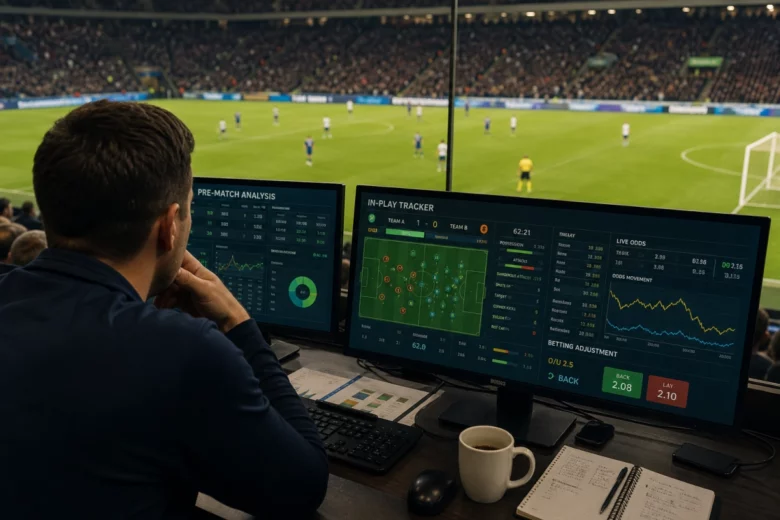
- Live (in-play) betting: Bets placed while the match is ongoing; prices change with match state.
Practical, observable measures of on-field and managerial leadership
To use leadership in football teams for betting, focus on measurable or consistently reported indicators rather than impressions alone. Useful, verifiable proxies include:
- Captaincy and role consistency: Frequency of captain starts, minutes as captain, and whether the captain also takes set pieces or penalties (shows responsibility).
- Experience and minutes: Squad age profile, total minutes for senior players, and number of starts in pressure matches (cup ties, relegation battles).
- Defensive organisation metrics: Team clearances, interceptions and successful defensive actions per match — leaders often drive organisation, which shows in defensive stability.
- Key actions under pressure: How often a player wins aerial duels, blocks shots or makes recovery tackles in late stages — measurable via trusted stats providers.
- Managerial game influence: Substitution patterns, tactical changes mid-game and past records of comebacks or protecting leads.
- Reliable qualitative sources: Manager and player comments, press coverage and consistent TV/analyst observation about vocal leadership or dressing-room influence.
These indicators let bettors assign a simple leadership score per team (for example: captain impact, veteran presence, vocal leadership, manager influence). The score then adjusts the subjective probability you assign to outcomes and the markets you prefer. Remember that statistics describe tendencies, not certainties.
Next, the guide will show a practical scoring system, concrete examples of translating scores into specific pre-match and in-play market adjustments, and rules for stake-sizing and risk control.
A simple, repeatable leadership scoring system
To make leadership actionable, convert observations into a compact, repeatable score you can apply pre-match and update in-play. Use a five-axis model, each scored -1, 0 or +1, summed to give a -5 to +5 leadership index. Keep definitions strict so different matches are comparable.
– Captain impact (+1/0/-1): +1 if the regular captain starts and routinely takes set pieces or penalties; 0 if a nominal captain without set-piece responsibility; -1 if captaincy is unstable or missing.
– Veteran presence (+1/0/-1): +1 if multiple starters are >30 years with recent minutes in pressure games; 0 if average squad age; -1 if the XI is unusually young or inexperienced.
– Vocal communicators (+1/0/-1): +1 where consistent analyst/TV reports and past match clips show audible on-field leadership or visible direction; 0 if mixed evidence; -1 if reports indicate a quiet dressing room or leadership void.
– Defensive organisation (+1/0/-1): +1 for teams with steady defensive metrics (clearances, interceptions per 90) and few late collapses; 0 for average metrics; -1 for teams prone to late defensive lapses.
– Managerial control (+1/0/-1): +1 if the manager has a track record of effective in-game adjustments and calm rotations; 0 if inconsistent; -1 if substitution patterns are reactive or indecisive.
Example: a side with a steady captain (+1), two veterans (+1), vocal leaders (+1), but shaky defensive organisation (-1) and a new, untested manager (-1) scores +1 overall. Record the raw sub-scores alongside the total — you’ll use these to explain specific market moves (e.g., veteran presence but poor defensive organisation suggests resilience under pressure but vulnerability late on).
Calibrate your probability adjustments before risking money. A simple starting rule: convert each +1 into a 2–4% positive shift in a team’s implied win probability pre-match, and each -1 into a 2–4% negative shift. Adjust the percentage range based on league-level variance (higher leagues, smaller shifts; lower leagues, slightly larger shifts). Always backtest on previous fixtures for a month and refine your multipliers.
Translating scores into specific pre-match and in-play market adjustments
Use the leadership index to tilt both market selection and stake confidence — which market to prefer, and how aggressively to take a perceived edge.
Pre-match adjustments
– High leadership score (+3 to +5): favour markets that reward match control and resilience — match-winner (1X2) or draw-no-bet if prices compress; smaller handicaps in Asian markets (e.g., -0.5) are reasonable. Increase implied win probability by your calibrated 2–4% per point and look for bookmakers who lag this adjustment.
– Neutral score (-2 to +2): stick to conventional overlays (form, tactics) — leadership is not decisive; prefer conservative markets like double chance or BTTS depending on attacking metrics.
– Low score (-3 to -5): lean toward opponent or draw-heavy markets; consider backing alternatives (e.g., under 2.5) if poor leadership correlates with late-game breakdowns.
In-play adjustments
Translate live events into rapid re-scoring:
– Captain sent off or injured: subtract 1–2 points depending on centrality; immediately tighten stakes and consider hedging live (cash out, lay markets or back draw/double chance).
– Substitution patterns signalling control (veteran on to calm game, manager shifts to defensive shape): add +1 to managerial or veteran axis; move into low-variance markets like draw-no-bet or low-line Asian handicap.
– Late-game trailing scenario with high leadership score: increase estimated comeback probability — target markets that capture single-goal swings (correct score ‘1-goal’ lines, Asian +0.5, or value on closing-window goals). Size stakes modestly and use short windows (place, then reassess after three minutes).
Practical examples: a pre-match +3 side at 2.80 implied has a 35.7% raw chance. Add 6–12% (two points at 3–4% each) to your subjective probability, moving your fair value price to roughly 2.3–2.6 — if the market is above that, you have value. In-play, if that team concedes and trails 0–1 at 60’ yet retains +3 leadership and brings on a calming veteran, your estimated comeback chance might double relative to a low-leadership side — move into comeback-friendly markets accordingly.
Combine the index with disciplined stake-sizing and stop-loss rules (next section) to ensure leadership signals refine decisions without exposing you to uncontrolled variance.
Quick implementation checklist
- Before placing a bet, record starting XIs and any captain or veteran absences; compute the leadership index and note sub-scores.
- Calibrate probability shifts on a small sample of historical matches and fix your percent-per-point multipliers before staking with real money.
- Define clear stake-sizing and stop-loss rules tied to bankroll percentage and event-driven re-evaluation (e.g., red card, tactical substitution).
- Log every decision: pre-match rationale, in-play changes, final outcome and post-match review notes to refine the system.
- Use leadership measures as one input among many — cross-check with form, injuries, tactics and bookmaker behaviour before acting.
- Limit in-play reaction windows: act quickly after clear new information, then reassess after a short period rather than chasing transient odds swings.
Final considerations for responsible use
Leadership metrics can add a useful lens to your betting process, but they are not a magic formula. Treat them as probabilistic nudges that should increase clarity, not certainty. Maintain disciplined bankroll rules, keep thorough records, and review outcomes objectively so your scoring and weighting evolve with real results. Above all, apply these methods responsibly — bet within your limits, avoid escalating after losses, and remember that models are tools to guide judgement, not replace it.