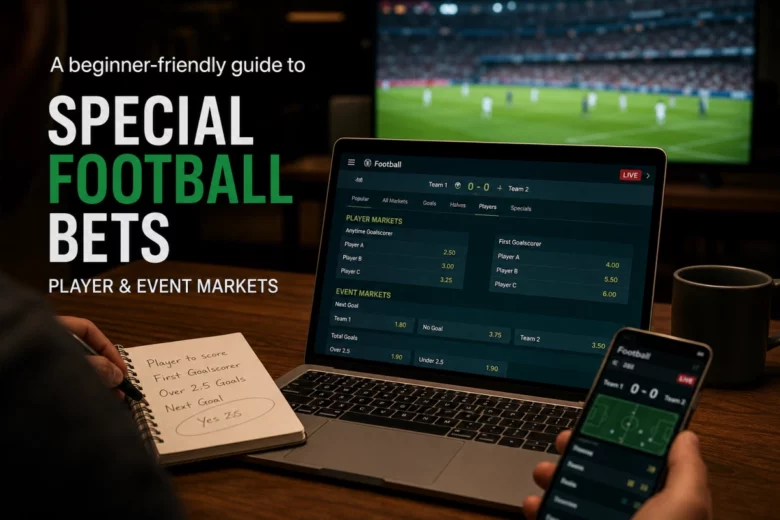
Special football bets explained: player and event markets for beginners
Special football bets—markets that focus on individual players or specific match events—are popular with bettors who want alternatives to match-result or handicap markets. These include first goalscorer, anytime scorer, exact minute, corners, bookings and penalties, substitutions, and other niche in-play events. This part introduces how these markets work, what moves prices before and during matches, and which statistics and match signals matter when looking for value.
How player and event markets work and common market types
Special markets are often categorical (who scores), numeric (how many corners), or timing-based (exact minute of a goal). Bookmakers set odds based on probability estimates and adjust them as new information arrives. Liquidity varies: top-player markets (e.g., star strikers) are more liquid than obscure events (e.g., first substitution time), which affects available stake sizes and price stability.
Key market definitions
- First goalscorer: Bet on which player scores the first goal in a match. Void if no goals are scored (depending on bookmaker rules).
- Anytime scorer: A player to score at any time during the match.
- Exact minute/interval: Wager on the minute or time window of a goal.
- Corners and bookings: Totals or player/event-based bets (e.g., number of corners, card for a specific player).
- Penalties and substitutions: Bets on whether a penalty will be awarded or when substitutions occur.
- Niche in-play events: Examples include next set-piece, next throw-in, or which player will receive a yellow card next.
What moves prices: statistics and match signals that matter
Understanding which factors influence prices helps bettors identify value. Bookmakers respond to pre-match data and live match signals; sharp traders and market makers can move lines quickly.
Pre-match signals and useful statistics
- Player form and minutes: Recent goal involvement, starting minutes and role in team tactics affect scorer markets.
- Team attacking patterns: Expected goals (xG), shots in the box, and set-piece frequency are relevant for goals and corner markets.
- Disciplinary records and referee tendencies: Players with high card rates or referees who issue many bookings influence booking markets.
- Lineup news and injuries: Late absences or rotated squads can create market movement and spotting value.
- Motivation and context: Competition importance, fixture congestion and rotation plans alter likely event probabilities.
In-play signals that move odds
- Early dominance (possession, shots on target, corners) often shortens odds for a home player to score next.
- Substitutions can open value on late goalscorer markets if an attacking player enters.
- Accumulating fouls, pressure spells and time-wasting change the likelihood of bookings or penalties.
- Market momentum: sharp money and live traders can quickly change prices; watching line movement helps separate informative moves from noise.
Recognising these signals and combining them with basic statistics helps bettors form a more realistic view of probability and spot value before kick-off and during the match. The next section will examine market liquidity, bookmaker limits, simple strategies for special football bets and practical stake-management techniques.
Market liquidity, bookmaker limits and how to shop around
Liquidity and betting limits materially affect how you can act on special markets. Unlike match-result markets where large stakes are common, many player/event lines have strict max stakes or opaque exposure—especially for low-profile markets (exact minute, first substitution, niche in-play events). Expect the following dynamics:
– Pre-match vs in-play liquidity: Pre-match liquidity is determined by bookmaker risk models and early customer flow; in-play liquidity is often thinner and more reactive. A thin market can mean rapid price swings after even a single bet or obvious game event.
– Maximum stakes and price shading: Bookmakers publish maximum stakes for many prop markets, or they may accept a stake then limit your account afterward. Sharp or unusual betting patterns can trigger reduced limits, especially if you consistently win on special markets.
– Exchanges vs bookies: Betting exchanges generally offer deeper liquidity on popular player markets (top scorers, cards for marquee players) and enable matched lay bets and trading. However, exchanges also thin out on obscure markets and late in matches.
– How to shop around: Use multiple bookies and an exchange account. Compare implied probabilities rather than just decimal odds (convert odds to percentages) and factor in commission. Smaller moves can be worth switching provider—an extra 5–10% in price multiplies long-term ROI.
Practical tips: set up odds alerts for players/events you follow; place bets early on value but be ready to hedge in-play; know the published max stake so you don’t get half-matched. If you find consistent edges, consider negotiated limits or VIP lines with bookmakers, or scale presence across several accounts to avoid quick account restrictions.
Simple strategies for special football bets (pre-match and in-play)
Special markets reward a mix of pre-match research and reading live match flow. Here are straightforward, low-complexity strategies suited to beginners.
– Value-first-goalscorer (pre-match): Identify players whose odds overestimate rotation risk. A striker with strong xG per 90, confirmed start, and weak opposing full-back can be mispriced. Target odds where implied probability is below your estimate by 10–20%.
– Anytime scorer laddering: If you like a player but want a safety net, split stakes between anytime scorer and a smaller exact-minute or time-interval bet—this reduces variance while keeping upside.
– Next-event scalping (in-play): Watch short-term indicators—shot attempts, corners, dangerous attacks. If a team racks up corners and gets the ball in the box repeatedly, back next goal or next corner at short odds and trade out after the immediate chance passes. Keep exposure small due to volatility.
– Booking/penalty situational plays: Target matches with aggressive referees, high-stakes derbies, or teams with disciplinary records. Pre-match card markets can be beaten by monitoring referee assignments and recent card fouls per 90.
– Hedging/trading: If a first-goalscorer bet wins early in-play, consider laying the same player after they score to lock profit. Conversely, if you back a player to score and he is subbed off, accept the loss or hedge with a small opposite bet if price allows.
Always use small, test-sized stakes to validate a strategy and keep a log of outcomes to refine edge estimates.
Stake management and responsible gambling for volatile event markets
Special markets are high-variance. Use disciplined stake management to protect your bankroll:
– Unit sizing: Base a unit on a percentage of your total bankroll—common ranges are 0.5–2% per standard bet for volatile events. Use smaller units (0.25–1%) for niche, low-liquidity markets.
– Loss limits and session caps: Set a per-match and per-day loss cap (e.g., 3–5% of bankroll per session). Stop once reached to avoid chasing losses during volatile live swings.
– Fractional Kelly for experienced users: The Kelly criterion can size bets by edge, but it’s risky if your edge estimate is noisy. If you use Kelly, apply a conservative fraction (e.g., 10–25% of full Kelly).
– Record keeping and review: Track stakes, odds, expected value, outcome, and rationale. Review monthly to identify leaking bets or strategies that don’t scale.
– Responsible gambling: Only bet with disposable income, set time and deposit limits, take regular breaks, and use bookmaker tools (deposit limits, self-exclusion) if needed. If gambling causes distress or financial harm, seek professional support or use available self-help options.
These practices reduce the chance that short-term variance erodes your bankroll and keep betting a controlled, analytical activity rather than an emotional one.
Putting special bets into practice
A short practical checklist before you stake
- Confirm the starting lineup and role for any player you back (minutes and position matter more than reputation).
- Check referee and team disciplinary tendencies only for card/penalty plays.
- Compare prices across a couple of bookies or an exchange—small edge compounds over time.
- Decide a unit stake and maximum loss for the session; stick to it.
- In-play: wait for a clear, short-term signal (shot on target, corner sequence, substitution) before increasing exposure.
Common pitfalls to avoid
- Chasing losses after a run of bad variance—special markets are high-variance and require discipline.
- Overconfidently assuming big-name players will play full matches—rotation and tactical changes are frequent.
- Ignoring liquidity and max-stake limits; always check a market’s capacity before sizing a bet.
- Relying solely on raw counting stats without context (e.g., xG and shot location often beat simple shot counts).
Final mindset
Think of special bets as a skill to develop: combine measured pre-match research, disciplined in-play reading, and conservative stake management. Treat each idea as an experiment—size bets to test hypotheses, record outcomes, and refine what actually works for you. With patience and control, these markets can add variety and opportunity to your betting, while keeping risk manageable.