How leadership in football teams changes momentum and creates betting opportunities
Why bettors should track leadership before placing a stake
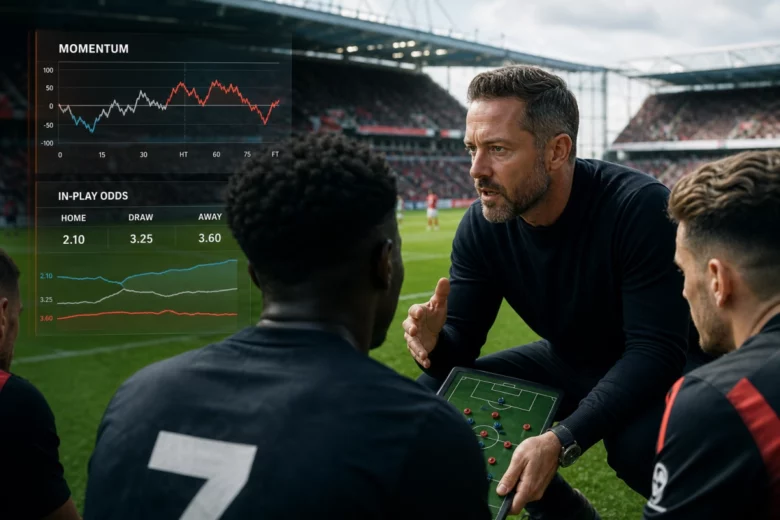
Leadership in football teams is one of the less obvious — but highly influential — match factors. Captains, experienced cores and on-field tactical leaders affect how a team responds to pressure, absorbs setbacks and controls tempo. For bettors this matters because leadership shapes match momentum, increases or reduces in-play volatility and can cause market moves (odds drifting or shortening) when visible triggers appear.
Understanding these effects helps bettors choose markets that reflect the likely psychological and tactical resilience of a side. It also helps avoid overreacting to noisy signals such as a late substitution or an early yellow card when a team’s leadership profile suggests steady recovery.
Pre-match leadership checklist every bettor can use
Before kickoff, run through a short checklist to gauge leadership strength. These items are verifiable from team sheets, recent matches and press information — do not invent or assume undocumented traits.
- Captaincy record: Who wears the armband regularly? A permanent captain with long minutes suggests continuity; rotating captains increase uncertainty. Stable captaincy often correlates with steadier in-play markets.
- Experienced core: Check minutes and starts for senior central positions (centre-back, holding midfield, central striker). Experienced cores usually organise teammates and calm moments of chaos.
- Leadership continuity: Note recent lineup changes. Heavy rotation, injuries or suspensions in leadership positions can reduce on-field composure and increase the chance of volatile market swings after incidents.
- Managerial influence: Some managers provide strong sideline leadership and clear tactical fixes; others leave more to player initiative. A manager known for quick tactical changes can limit momentum losses.
- Disciplinary and temperament signals: Frequent bookings or red cards from certain players can be double-edged: they might lead to penalties in player-prop markets or signal a volatile in-play profile.
- Contextual factors: Fixture congestion, hostile away fans or a must-win scenario can amplify the leadership effect (positive or negative).
How basic betting markets relate to leadership signals
Translate checklist findings into market choices:
- Match result / Draw No Bet: Strong leadership suggests resilience — favourable to backing outright or using Draw No Bet to reduce downside.
- Asian handicap: If leadership is compromised (missing captain or core), consider lighter handicap exposure; when leadership is strong, smaller favourable handicaps are more attractive.
- Both Teams to Score (BTTS) / Over-Under goals: Teams with on-field leaders who control tempo may keep games lower-scoring; fractious teams often produce higher volatility and goals.
- Red-card and player-prop markets: Players with poor disciplinary history or visible emotional leadership are risk factors — useful for targeted props but higher variance.
Next, the guide will examine the in-play leadership triggers — substitutions, injuries, bookings and visible vocal leadership — and show how to convert live observations into concrete in-play betting actions and hedge decisions.
In-play leadership triggers and immediate market cues
Not all in-play events are equal for leadership impact. Treat leadership triggers as a short list of observable, verifiable moments that can meaningfully shift momentum — then watch how markets react in the following minutes.
Key triggers to watch (and the initial market cues they typically produce):
– Substitution of a captain or experienced core (centre-back, holding midfielder, striker): teams often show a brief organisational wobble. Expect immediate drift in the substituted side’s match-winner odds and Asian handicap; liquidity may shift toward the opponent as traders price increased fragility.
– Injury to a leader: similar to substitution but more acute if the replacement is clearly less experienced. Odds can drift faster and by a larger margin, especially if the injured player covers a central role.
– Yellow card / red card to a leader: a booking for a vocal leader can reduce their on-field influence; a red card creates binary outcomes (man advantage) and usually produces sharp market movements — match result and handicap markets react first, BTTS and over/under respond as teams open up.
– Visible vocal leadership or collapse: a captain organising teammates after a setback often stabilises the price; conversely, visible arguing, shouting or retreating tends to increase volatility. These are qualitative signals but verifiable via TV feed and live commentary.
– Manager intervention (sideline tactical change or animated instructions): when managers are visibly directing structure, markets usually temper extreme moves because bettors assume quicker tactical fixes.
Timing matters. Markets rarely settle instantly — most reactive flows complete in the 2–7 minute window after an event. A strong leader returning from a knock, or a calm reorganisation by a captain, can reverse initial odds drift within that window. Conversely, clear leadership collapse tends to be followed by a sustained market move.
Translating observations into concrete in-play betting actions
Turn observed triggers into disciplined trades rather than gut stakes. Use the following rule-set examples tied to market types:
– Match result / Draw No Bet (DNB): If an experienced captain is subbed off early and the replacement is inexperienced, consider a small hedge (lay or back opponent) or switch to DNB to retain upside while cutting downside. If leadership visibly steadies after 5 minutes, avoid chasing the original position back immediately.
– Asian handicap: When leadership is compromised, reduce exposure — move to a lighter handicap or close half the position. If a leader is introduced (an experienced sub) and the team steadies, consider scaling back into a favourable Asian line when it shortens.
– Both Teams to Score / Over-Under: A vocal leader calming play tends to reduce immediate goal probability; if you observe organised ball retention after a trigger, odds for under goals will shorten — consider backing under in the 10–30 minute window. Conversely, leadership collapse or a red card often creates short-term over/BTTS value.
– Red-card and player-props: If a known hot-headed leader receives a booking and starts to show dissent, targeted player-card props (next card, card-accumulation) become tradable. Use small stakes; these markets are high variance.
– Next-goal / time-limited markets: These can be exploited when leadership events create clear temporary imbalance (e.g., opponent playing with ten men). Attack quickly if odds move in your favor, but size stakes modestly and exit if the statistical edge evaporates after the first few minutes.
Practical execution tips: wait 1–3 minutes after the trigger unless the event is extreme (straight red). Scale in with smaller stakes and use cash-out or lay hedges rather than doubling down. Keep stake sizes proportional to confidence — a rough guide: single-digit percent adjustments of your usual stake for uncertain qualitative signals, higher only for clear numerical advantages (e.g., opponent reduced to 10 men).
Limitations, signal verification and avoiding overreach
Leadership signals are probabilistic, not deterministic. Verify every observation with solid, verifiable evidence: official team sheet changes, live TV footage, reputable live commentary and real-time stats (possession, pass completion, defensive errors). Don’t assume leadership ability from reputation alone — recent minutes played, position and visible behaviour in the match are the data points that matter.
Common pitfalls:
– Confirmation bias: looking only for evidence that supports a pre-match view.
– Small-sample illusions: one vocal moment doesn’t guarantee sustained collapse or revival.
– Overtrading: reacting to minute market noise without a clear edge.
Markets sometimes overreact — an initial odds spike after a captain substitution can partially revert once bookmakers absorb the event. Act only when your observation increases the perceived probability enough to overcome the bookmaker margin and execution costs.
Finally, maintain disciplined bankroll controls and predefined stop-losses. Treat leadership-based trades as an overlay to your standard model, not a replacement. Keep a log of triggers, your interpretation and the market outcome to refine pattern recognition over time.
Track, test and iterate
To turn leadership observations into a repeatable edge, treat them like any other predictive signal: log events, measure outcomes and refine your rules. Consistent record-keeping separates lucky hits from real edges.
- Journal fields to capture: match, minute, trigger type (sub, injury, card, vocal), player(s) involved, immediate market move, bet placed (market, stake), result and net P/L.
- Review cadence: run weekly summaries for in-play trades and monthly reviews for pre-match leadership decisions. Look for patterns by competition, manager style and player roles.
- Simple metrics to track: hit rate, average return per trade, average market move after a trigger and average time-to-reversion. Use these to size future stakes and refine time windows (e.g., 2–7 minutes after an event).
- Validation guardrails: require two independent verifications for qualitative signals (official substitution notice + TV feed or reputable live commentary) before increasing stake sizes.
Applying leadership analysis responsibly
Leadership-based betting is a practical overlay, not a silver bullet. Use it to adjust probabilities, hedge exposure and identify short-lived in-play opportunities — always within the constraints of bankroll management and disciplined record-keeping. Start small, test systematically, and accept that variance will be significant even for well-observed signals. When you encounter strong, repeatable patterns, scale incrementally rather than betting large from the outset.
Keep responsible-gambling principles at the centre of your approach: predefined stake limits, automatic stop-losses, rested decision-making and seeking help if wagering stops being enjoyable or controlled. Leadership cues give you another lens on match dynamics; used thoughtfully, they can improve timing and selection. Used carelessly, they increase noise and risk. Let verification, testing and restraint guide how you apply them in the markets.