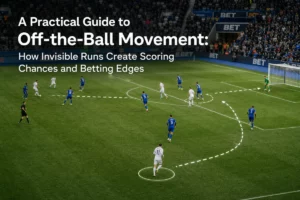
Why your positioning away from the ball can decide close matches
When you watch the top teams, you see players who seem to be in the right place before the ball arrives. That’s not luck — it’s deliberate positioning. Off-the-ball movement creates passing angles, stretches defenses, and opens the channels that let teammates operate. If you improve how you occupy space and time runs, you’ll make your side easier to play through and harder to defend against.
Positioning away from the ball affects every phase: possession build-up, progression, and transitions. Even without the ball, you carry responsibilities — to create options, to deny opponents lines of play, and to be ready for second-phase actions. You can become the player who wins moments that decide matches by mastering a few practical concepts and practicing them until they become instinctive.
Read the pitch: spatial awareness and timing
Your first task is to develop pitch-reading skills. Spatial awareness combines three elements: where teammates are, where opponents are, and where the ball can go next. Use the following checklist while you’re on the field:
- Scan frequently: Short, regular scans let you update your mental map of player positions and space. Scanning for 1–2 seconds every time the ball moves is a good habit.
- Identify pocket spaces: Look for small, exploitable pockets between defensive lines or next to an opponent who’s slow to shift.
- Anticipate the next pass: Think one pass ahead — where will the ball realistically go and how will defenders react?
Timing is as important as placement. A perfectly placed run five seconds too early or late can be useless. Practice syncing your movement to the rhythm of your team’s passing — moving into a lane just as a passer is about to release the ball ensures you receive in stride and keep play flowing.
Core positioning principles you must master
Adopt a small set of reproducible rules that guide your choices when you’re off the ball. These principles help you organize your movement under pressure and make better decisions instantly:
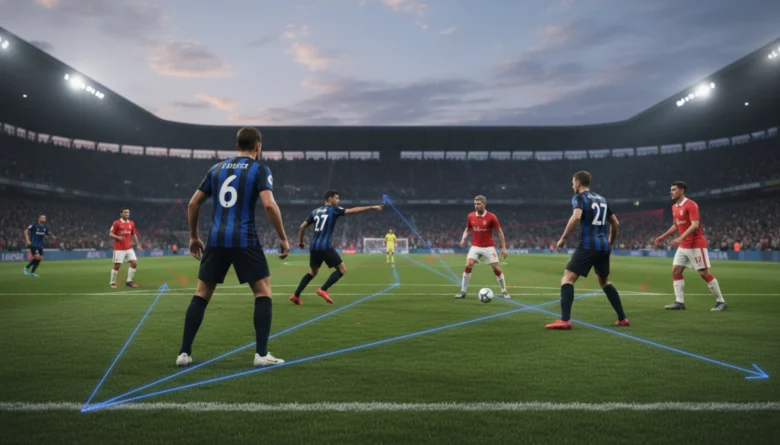
- Create passing angles: Position yourself to give the ball-carrier multiple options — wide, forward, and back. A good angle reduces the risk of turnovers.
- Occupy depth wisely: Stay high enough to support progression but deep enough to prevent counter-attacks. Balance between pressing forward and providing defensive cover.
- Exploit half-spaces: Half-spaces (between a fullback and a center-back) are often the most dangerous areas to occupy; use them to pull defenders out of position.
- Stay compact in defense: When out of possession, close gaps between lines to deny through passes and force opponents wide.
These rules are simple, but applying them under fatigue and pressure requires repetition in training. Next, you’ll get concrete examples for different positions plus drills that embed these habits into your match play.
Position-specific responsibilities: examples that change matches
How you occupy space depends on where you play. Below are concrete, repeatable actions for each line — not exhaustive but targeted, high-impact behaviours you can practice immediately.
- Strikers: Don’t just wait for through-balls. Drop into the between-lines to pull a centre-back out, then launch a timed diagonal run behind the back line when the midfielder plays forward. If you receive with your back to goal, open your body to lay off the ball into the half-space for a runner. Cue: when the ball-carrier looks for a forward pass, step wide and off the last defender’s shoulder to create the split.
- Wingers and wide midfielders: Stretch the pitch but vary your depth. Sit on the shoulder of the fullback to demand attention, then drift inside into the half-space to combine with an overlapping fullback or to be the third-man in a wall pass. Cue: if your fullback drives with the ball, occupy a half-space that lets you either receive between lines or peel into the box.
- Central midfielders: One player must release pressure by dropping into pockets; another pushes forward to occupy half-spaces. The deeper midfielder should provide vertical passing lanes and be ready to turn the ball under pressure. Cue: after a turnover, immediately become the outlet by offering lateral depth — don’t stand flat in the same line as attackers.
- Fullbacks: Alternate between width and underlap. If the winger cuts inside, go wide to keep the defensive line stretched; if the winger drifts short, underlap to create overloads or overlap to draw the centre-back out. Cue: move when the ball-carrier shifts weight — an accelerating run behind the defensive line is most effective when the opponent’s next shift is delayed.
- Centre-backs: Maintain depth to neutralize counter-attacks while stepping out to engage a dribbler when midfield cover is present. One CB can step wide to invite a pass behind while the other covers the gap. Cue: communicate first — call for cover before you pressure to avoid exposing a channel.
Drills that embed off-the-ball instincts
Turn intentional positioning into muscle memory with drills that replicate the decision-making speed and spatial complexity of matches. Use progressions: technical first, then add defenders, then time pressure.
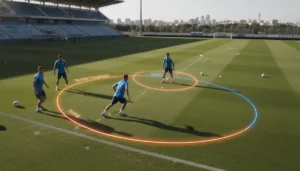
- Positional rondo (5v2 in zones): Create three narrow zones representing defensive, middle, and attacking thirds. Attackers must move between zones to progress the ball; defenders try to intercept. Focus: scanning, offering depth, and timing entries between lines. Progress by limiting touches or adding a neutral player who must be used as a third-man.
- Third-man run drill: Setup three players in a triangle with one defender. Player A passes to B, whose touch must displace the defender to open the channel for C’s run behind. Rotate roles. Focus: timing the run off B’s first touch and verbiage to signal intent.
- Wide overloads into box: 6v6 with two wide zones. Encourage underlaps, overlaps, and late runs into the box. Score by successful progressive passes or a finish. Focus: occupying half-spaces and delayed runs arriving on the shoulder of the last defender.
- Transition grids (3v3+4): Two small goals in each end; four neutrals provide outlets. On turnover, neutrals immediately change role. Focus: recovery positions, immediate outlets, and preventing counter lanes.
Coaching points for all drills: require vocal communication, enforce scanning before receiving, and reward successful positional choices with constrained scoring chances. Measure progress by counting completed progressive passes, successful third-man runs, and turnovers avoided under pressure. Repetition with feedback converts these concepts into instinctive, match-winning behaviours.
Integrating positioning work into a weekly plan
To make off-the-ball positioning stick, program it into training with clear progressions and measurable goals. Keep sessions short, focused, and repeatable so players build confidence and instincts.
- Monday — Recovery + video: review clips of desired positioning moments and mistakes.
- Tuesday — Technical-positional work: rondos and third-man run drills with low pressure.
- Wednesday — Tactical overloads: wide overloads and transition grids with game-like constraints.
- Thursday — Small-sided games: emphasize scanning and delayed runs; limit touches to speed decision-making.
- Friday — Set-piece and match prep: rehearse runs and defensive compactness; finalize roles.
Use objective markers (completed progressive passes, successful third-man runs, turnovers prevented) and brief post-session reviews to keep improvement visible and actionable.
Make off-the-ball positioning your competitive edge
Great positioning isn’t an occasional tactic — it’s a habit that separates good teams from great ones. Commit to the small, repetitive actions: scan, offer angles, time runs, and insist on communication. Those habits compound over matches, turning half-chances into goals and limiting opponent opportunities.
Coaches should reward smart positional play as much as technical flair; players should seek feedback, study footage, and rehearse the drills until reactions become automatic. For practice ideas and coaching resources, explore reputable coaching hubs such as UEFA Training Ground to adapt high-level methods to your group.
Start small, measure what matters, and hold each other accountable. When your team consistently wins the invisible battles off the ball, the visible results on the scoreboard will follow.