Why mastering off-the-ball runs changes how you and your team score
You already know possession and passing are important, but off-the-ball movement often decides who creates the real scoring chances. Off-the-ball runs are the deliberate movements you make without the ball to manipulate defenders, open channels, and give teammates better passing options. When you perfect these runs you force opponents to make choices, create mismatches, and often get the final decisive touch in the box.
What an effective run does for you on the pitch
An effective off-the-ball run accomplishes one or more of the following: creates a direct chance on goal, pulls defenders out of position to free a teammate, or acts as a decoy to open weak-side space. You should think of your run as both an attacking tool and a communication method — it signals intent and reshapes the defensive shape even before you receive the ball.
- Create depth: Runs that move behind the defensive line stretch defensive lines and generate through-ball opportunities.
- Open channels: Lateral runs or diagonal sprints can draw markers and open corridors for overlapping fullbacks or central midfielders.
- Distract or decoy: A well-timed run can pull a center back wide, creating a numerical advantage elsewhere.
Core principles and common run types you must practice
To make your runs effective you need to master timing, angle, tempo, and intent. These are not random sprints; they are coordinated actions with a clear objective. Below are core principles to apply every time you move without the ball, followed by the main run types used in modern football.
Principles: timing, angle, tempo, and communication
- Timing: Start your run when your teammate’s body or eye-line indicates a pass is available, or just before to create momentum for a through ball.
- Angle: Attack the weakest point in the defensive shape — diagonals and blind-side runs often beat straight-line markers.
- Tempo: Vary your speed. A slow false start followed by a burst is harder to read than a constant sprint.
- Communication: Use eye contact, hand gestures, or short calls to coordinate with the passer so they know when and where you’ll arrive.
Common off-the-ball runs and how to use them
- Penetrating (through) runs: Run in behind the defense for a through ball. Use at pace and time it to avoid offsides.
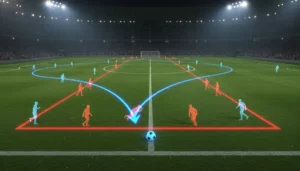
- Diagonal runs: Combine with a winger or fullback to drag a central defender out of position and open the half-space.
- Blind-side runs: Attack the defender’s weaker side — often unseen by the marker and ideal for quick flicks or low crosses.
- Decoy/occupying runs: Run deliberately to occupy a key defender and create room for another attacker to exploit.
- Check and go: Briefly check towards the ball to mislead a marker, then explode into space for a return pass.
These principles and run types form the tactical vocabulary you’ll use every game. In the next section you’ll get specific drills, visual cues, and positional tips to practice these runs on the training ground and apply them under match pressure.
Training drills to ingrain smart off-the-ball runs
To make these runs automatic under pressure you need rehearsed patterns that simulate match cues. Use progressive drills that force timing, deception, and finishing under realistic constraints.
– Two-player through-run drill: Pair up with a passer. Start wide, checker in toward the ball, then explode into the channel behind two cone “defenders.” Vary the starter delay (0.5–2 seconds) so the passer adjusts timing. Coaching points: accelerate at full speed, angle your run toward the near post if the ball is played early, and practice receiving on the run with a first touch away from the defender.
– Three-man finish with decoy: Set a central striker, a wide attacker, and a third player making a decoy run. The ball is played from the wide player; the decoy drags the center back, creating space for the striker’s penetrating run. Add a fullback overlap to work combination timing. Progress to live defenders to force reactive decisions.
– Check-and-go rondo: In a small possession grid, have an outside player briefly check toward the ball then sprint into the opposite corridor. The passer must recognise the check and play a line-breaking ball. This sharpens eye contact cues and tempo changes.
– Crossing + blind-side runs: Run crossing patterns where the near post attacker decoys while the striker times a blind-side run into the far post. Work different crossing heights and delivery points so attackers learn to attack space, not just the ball.
– Transition sprint-to-finish: Coach yells “turn” to simulate a turnover. Immediate counter-attack: two quick passes followed by a through run behind a retreating defense leading to a finish. This trains pace and decision-making in transition.
Always finish drills with a shot or cross to reinforce the connection between movement and end product. Add pressure (defenders, time limits) progressively so runs survive under match stress.
Position-specific tips: how each role exploits space
Different positions exploit different channels; adjust your runs to the half-space, wide corridor, or in-behind gaps your role naturally accesses.
– Strikers: Prioritise blind-side and penetrating runs. Watch the defensive line for gaps between center backs and fullbacks and attack those pockets. Vary your tempo — a hesitation followed by a hard sprint is lethal. Work on finishes from low crosses and one-touch flicks.
– Wingers and wide forwards: Use diagonal runs into half-spaces to pull fullbacks and create lanes for overlapping fullbacks. Cut inside at pace when the fullback is late to recover; if the defender shows you, attack the blind side near post.
– Fullbacks: Time overlapping runs to the passer’s body orientation; sprint wide if the winger checks inside. When playing inverted, make underlapping runs into the half-space to create overloads with central midfielders.
– Central midfielders: Use late arriving runs into the box — arrive after the initial pass to avoid early markers. Diagonal late runs are especially effective from deeper midfielders because they’re harder to track.
– Defenders (outgoing plays): Centre-backs with good passing can step into midfield to draw a forward marker, creating space behind them for forwards’ penetrating runs. When pushing high, be ready to make short diagonal passes into a dropping midfielder who can release a runner.
Recognise defensive body shapes and trigger your run when a defender’s weight, head orientation, or shift in position reveals a gap.
Applying runs in transitions and set phases
Off-the-ball runs are most valuable during transitions and set pieces — moments where defenders are disorganized.
– In counter-attacks, prioritise vertical penetrating runs and immediate width. The quicker your runs start, the fewer defenders will have recovered. Train long, accurate passes to meet those runs.
– On set pieces, choreograph blocking runs and late arriving attackers. Use decoys to occupy markers; a two-step delay before the run can deceive zonal markers. For corners, mixing near-post runs with far-post penetrations forces marking confusion.
Practice these scenarios in small-sided games and conditioned scrimmages so players learn to recognise triggers and execute under fatigue. Successful off-the-ball runs become a team habit — one that consistently opens space and turns possession into goals.
From training ground to match impact
Turning off-the-ball runs into a reliable team weapon is less about grand tactics and more about daily habits: rehearsal under pressure, clear triggers, and shared intent. Prioritise deliberate repetition in training, use video to reinforce what worked, and keep communication simple on the pitch. For ready-made drill progressions and coaching frameworks to structure sessions, see UEFA coaching resources.
Quick action checklist
- Schedule short, focused sessions that isolate one run type each week.
- Film training and mark the moments when runs create space or fail — discuss adjustments.
- Design small-sided games that reward successful runs with direct finishing opportunities.
- Assign simple in-game signals (eye contact, hand cue) so passers and runners sync instinctively.
- Rotate roles in practice so players understand the timing and perspective of teammates.
Final note
Make off-the-ball movement a team identity rather than an individual trick. When everyone accepts responsibility for creating and recognising space, scoring chances rise naturally — and those runs become the rhythm that wins games.