Why off-the-ball play is the hidden engine of your team’s success
You already know that goals and tackles grab headlines, but the way players move without the ball often creates the moments that win games. When you train off-the-ball intelligence, you equip your squad to open space, create overloads, and punish defensive lapses. As a coach, your task is to help players read cues, coordinate runs, and understand positional responsibilities so their actions become predictable to teammates and unpredictable to opponents.
This section explains why prioritizing off-the-ball development early in your plan delivers higher returns than isolated technical drills. You’ll learn how to evaluate current movement habits and set early objectives that become the foundation for advanced team tactics.
Assessing movement and decision-making: what to measure first
Before you prescribe drills, you must diagnose. Your assessments should be simple, repeatable, and focused on three measurable domains:
- Spatial awareness: Does the player scan and use available space? Track frequency of head checks in small-sided situations and the ability to occupy half-spaces.
- Timing of runs: Does the player arrive late or early into channels and the box? Note the delay between receiving visual cues and initiating movement.
- Positional discipline: Does the player maintain team shape when out of possession and balance when attacking? Monitor how often they leave their zone at inappropriate times.
Use micro-sessions and video clips to capture behaviors. A consistent assessment routine might include a 6v6 small-sided game, a pattern-of-play drill, and a defensive transition exercise. Record simple KPIs such as successful supporting runs, misplaced runs that broke shape, and instances of effective decoy movement. These KPIs give you objective starting points for individual and group coaching goals.
Early training objectives you can implement this week
Translate assessments into actionable objectives that you can coach in the next few sessions. Keep goals specific, measurable, and time-bound so players understand expectations and you can track progress.
- Increase purposeful supporting runs per 15-minute small-sided game from X to Y by emphasizing scanning and first-touch orientation.
- Reduce inappropriate channel departures by 30% across two practice drills through enforced positional recovery exercises.
- Improve timing of attacking runs into the box by practicing three cue-based repetition sequences per session (ball carrier glance, teammate call, or target line crossing).
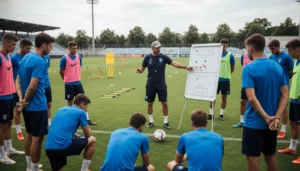
Design practice tasks that isolate one objective at a time. For example, a 4v4 with fixed defenders and moving targets forces off-the-ball players to time their runs and choose when to occupy pockets of space. Use immediate feedback loops: stop the drill, show the clip, and reset with a single corrective point.
Having set clear assessments and early objectives, you’re ready to structure progressive drills and session plans that build off-the-ball habits into match-ready instincts. Next, you’ll explore progressive drills, periodization, and coaching cues that accelerate learning and transfer to competitive play.
Progressive drills that layer decision-making and movement
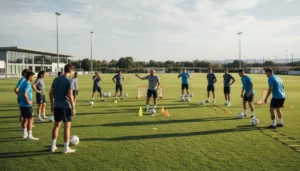
Start with drills that isolate a single off-the-ball concept, then add pressure, variability and tactical context. Progressions should be short (3–6 minutes per variation), repeatable, and mapped to one KPI you recorded in the assessment phase.
Example progression: Teaching timing into the box
– Drill A — Cue-based arrival (6v4 rondo with two target boxes): Attacking team must play through three passes before the designated striker times a run into a small box. Cue = final pass receiver’s call. KPI: successful on-target arrivals per set.
– Drill B — Passive defenders become active: Same shape but defenders can step out to close the box on the striker. Add a neutral who recycles the ball. KPI: striker still arriving on time under pressure; touches received in the box.
– Drill C — Match-context overload (9v7 pattern play): Integrate full-width play so attackers must create half-space entries or decoy movements to free the striker. KPI: goals or key passes created from timed arrivals, decoy success rate.
Other high-impact drills
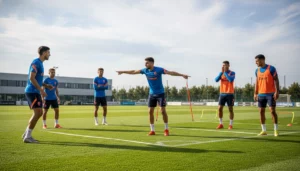
– Shadow runs with a purpose: Pair attackers; one makes blind (decoy) runs while the other times a run to receive a wall pass. Progress by allowing defenders to track the decoy.
– Channel rotation game (4v4+2): Wide players must interchange channels off the ball; mids provide cover. Constraint: only two touches for ball carriers — forces quicker scanning and decision to rotate or hold. KPI: successful rotations per minute, positional recovery time.
– Transition trigger drill (3-team possession): A live turnover triggers a sprinting runner from the third team to exploit the gap. This creates realistic cues for proactive runs on the counter.
Coaching structure during progressions
– Keep correction single-threaded: one technical point, one tactical point, maximum. Use “stop-show-start” after 2–3 repetitions.
– Preset success metrics: e.g., 70% of attempts meet the KPI before adding the next pressure layer.
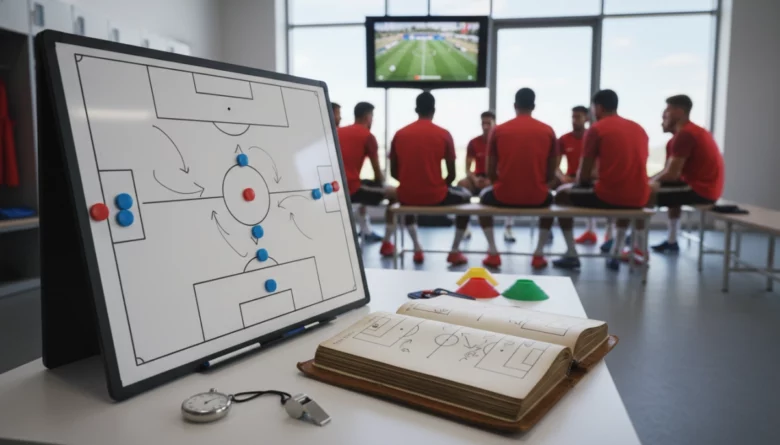
– Use short video clips mid-session to reinforce correct and incorrect examples — don’t overload players with long talks.
Periodizing off-the-ball development across the season
Plan off-the-ball work like you plan physical conditioning: phases that build a foundation, integrate complexity, then sharpen under match load.
Macro phases
– Foundation (preseason 4–6 weeks): Emphasize spatial concepts, scanning habits, and simple timing drills. Volume high, intensity low-moderate. Aim for 3–4 targeted reps per drill per session.
– Integration (early season 6–10 weeks): Add pressure, opposition, and team patterns. Link off-the-ball tasks with set plays and defensive shape. Reps become more variable; metrics shift from perfect execution to decision correctness under stress.
– Sharpening (in-season blocks): Reduce volume, increase match-like intensity and specificity. Focus on opponent-related cues (how to exploit a narrow back four, when to overload a fullback). Use small-sided games that replicate upcoming opponent tendencies.
Microcycle example (midweek)
– Day 1: Recovery + brief video review of off-the-ball KPIs (15–20 min).
– Day 2: Technical and tactical session — progressive drills (45–60 min).
– Day 3: Tactical rehearsal + situational scrimmage (30–45 min) — focus on patterns identified in opponent analysis.
– Matchday prep: short, sharp walk-throughs of movement cues (10–15 min).
Load management and measurement
– Track cognitive load as well as physical load; too many new off-the-ball concepts in one week reduces retention.
– Use simple weekly KPIs (supporting runs per SSG, successful rotations) and compare rolling averages every 2–3 weeks to decide when to progress or consolidate.
First 4 sessions: a practical starter
- Session 1 — Foundation: Simple scanning and support drills (20–30 min). Record baseline KPIs during a 6v6 SSG.
- Session 2 — Timing focus: Progression work on cue-based arrivals and shadow runs (30–40 min). Use immediate stop-show-start feedback.
- Session 3 — Integration: Add passive then active defenders; introduce channel rotations in a constrained 4v4+2 game (40–50 min).
- Session 4 — Match rehearsal: Short situational scrimmage with scoreboard objectives tied to off-the-ball KPIs; review clips and set 1–2 clear targets for the next week.
Putting the playbook into practice
This work rewards patience and persistence. Keep interventions focused, measure small wins, and be ready to simplify whenever learning stalls. Rotate responsibilities: allow senior players to lead micro-coaching moments, and use video clips to make invisible movement visible to the group. Track both objective KPIs and the less tangible — confidence to move without the ball and willingness to test new patterns.
For additional drill ideas and coaching frameworks you can adapt, explore UEFA Football Development and other coaching libraries — then translate what fits your squad’s context. Above all, build a culture that values off-the-ball intelligence: when players see movement as a team action, the tactical edge becomes sustainable and repeatable.