Why off-the-ball movement is the defensive difference
You can always be a stronger defender by improving what you do when the ball isn’t at your feet. Modern defending demands more than tackles and clearances: it requires anticipatory movement, intelligent covering, and coordinated team balance. When you move effectively off the ball you reduce risks, force attackers into predictable options, and buy time for teammates to recover. This section explains the core cues and thinking you must adopt before we move into practice progressions.
Key anticipation cues to focus on
Anticipation is the skill of predicting what will happen next so you can position yourself proactively. Train your eyes and body to read these reliable cues every session:
- Opposition body shape: The attacker’s hips and shoulders often point to the intended direction before the ball moves.
- Ball rhythm and speed: A quicker tempo often signals a forward pass or through ball; a pause can mean a change of direction.
- Teammate positioning: Where your teammates are (or aren’t) tells you whether you need to cover or close down.
- Space behind you: Constantly scan the channel and half-space you’re responsible for so you can step to cover or drop as needed.
- Trigger moments: Foot plant, head turn, or a weight shift in the attacker are micro-triggers that prompt your first step.
Principles of cover: how you support the on-ball defender
Covering is more than standing behind someone; it’s about angle, distance, and timing so you can intervene if the primary defender is beaten. Adopt these principles during training and match play to make your cover meaningful.
Practical cover rules to apply immediately
- Distance management: Be close enough to intervene (one to three strides depending on speed of play) but far enough to see both attacker and ball.
- Angle of cover: Position slightly to the side that forces the attacker into less dangerous channels—toward touchline or away from goal.
- Balance vs. commitment: Delay committing until the attacker’s trigger shows intent. Your role is to delay and channel rather than always win the ball immediately.
- Communicate early: Use short, clear calls to guide the on-ball defender and signal when you will step or switch roles.
Starter drills to build anticipation and cover
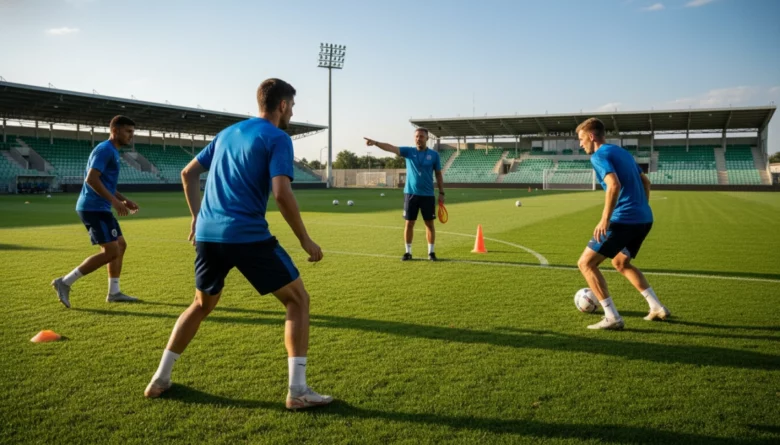
- Read-and-step shadowing: Pair up. One acts as attacker moving with the ball; the defender must mirror and react only to the attacker’s hips and planted foot over 20–30m. Coach calls random signals to change pace.
- Three-player cover rotation: Two defenders and one attacker. Defender A pressures; Defender B provides cover. Rotate roles after each sequence, focusing on distance and angle of cover rather than tackles.
Those principles and introductory drills set the foundation; in the next section you’ll get progressive training sessions, timed rep schemes, and coaching points to advance your anticipation and cover work under pressure.
Progressive session 1 — controlled repetition and cue refinement
This first progression converts the starter drills into focused, repeatable blocks that sharpen the micro-skills of anticipation and first-step cover. Keep the intensity moderate; the goal is patterning, not fatigue.
- Warm-up (8 minutes): Dynamic mobility + passing in pairs. Include 4 x 20m accelerations to prime first-step speed.
- Read-and-step with constraints (12 minutes): 3 sets x 6 reps. Defender mirrors attacker over a 20–25m corridor. On the coach’s whistle the attacker executes one of three options (dribble past, pass into channel, stop-and-turn). Rest 40 seconds between reps, 90 seconds between sets.
- Coaching cues: Force defenders to hold cover distance for 0.5–1s before committing; eyes on hips not ball; first step should be lateral and short (think “snap step”), not a chasing sprint.
- Feedback loop: After each rep give one concise corrective cue (e.g., “longer cushion”, “angle inside”, “delay”). Keep video or a mirror for 1–2 players at a time to self-review posture and angle.
Progressive session 2 — adding pressure, recovery and transitional cover
Now introduce dynamic pressure and quick transitional responsibilities so defenders learn to cover when the on-ball player is beaten and to manage recovery runs under fatigue.
- Three-player cover rotations — upgraded (15 minutes): Set up 3v2 sequences. Two attackers against three defenders (one engages, one provides cover, one recovery). Play 6 sequences per rotation, each lasting 20–30 seconds. Rotate roles clockwise. Rest 60 seconds between rotations.
- Trigger-based repetitions: Coach signals a trigger (pass, turn, tempo change). On signal, cover defender must step to intercept or channel; if beaten, recovery defender executes recovery run to deny a shot or reverse play. Track successful covers per rotation — aim for 70–80% correct positioning early, increasing to 90% by session end.
- Coaching points: Emphasize angle of approach for the cover defender (should create a 45–60 degree containment funnel), timing of the step (wait 0.3–0.6s after trigger), and economy of movement on recovery (curved sprint path to cut off direct line to goal).
- Progression: Reduce rest and increase repetition speed as competence rises; introduce a neutral target player to create quick transitional passes and force communication (“I’ve got,” “Drop,” “Cover”).
Integration — small-sided games and constraint drills to make it match-real
Transfer practiced habits into chaotic, decision-rich environments. Small-sided formats force defenders to apply anticipation and cover under realistic time pressure.
- 4v4 with directional targets (20 minutes): Two small goals on each end. Limit attackers to two touches; defenders may use unlimited touches. Play 6 bouts x 3 minutes with 90 seconds rest. Reward defensive success (forced turnover, blocked shot) with coach bonus points to encourage defensive intent.
- Timed recovery sprint game: Start from an attacking pass into a wing player; on a set whistle three defenders must reorganize into shape and stop the subsequent attack. Track time taken to reestablish cover positions — target under 6 seconds initially, then 4 seconds as standards rise.
- Coaching emphasis: Read the game two phases ahead — where the pass could go next and which teammate needs help. Reinforce communication: short, sharp calls and pointing; celebrate good recovery angles and measured delays rather than reckless tackles.
Monitoring progress and session planning
Track measurable cues so training transfers to match performance. Use simple, repeatable metrics and a clear weekly plan to keep improvements consistent.
- Positioning success rate — percentage of sequences where the cover position is correct at the moment of the trigger.
- Recovery time — average seconds taken to re-establish defensive shape after an attacker bypasses the first defender.
- Interventions per game-like rep — number of effective covers or delays that prevented a goal-scoring opportunity.
- Communication index — count of clear, audible calls per defensive sequence during small-sided games.
- Session load and progression — 2–3 focused defensive sessions per week: one patterning (low intensity), one pressure/recovery (moderate), one match-rep SSG (high intensity).
Next steps for defenders
Keep the emphasis on anticipation and coordinated cover as daily habits rather than occasional drills. Build short-term objectives (e.g., reduce average recovery time by 0.5s over three weeks) and pair them with video review and coach feedback. Encourage defenders to practice scanning and trigger recognition in warm-ups and to communicate constantly during game-like reps. For further study and drill ideas from established coaching programs, consult external coaching compilations such as UEFA Coaching resources.