How off-the-ball positioning shapes team performance
You already know that the ball rarely stays in one place during a match. What separates compact, fluid teams from disjointed ones is the quality of off-the-ball positioning — the decisions players make when they are not directly involved with the ball. When you focus on positioning, you improve passing options, reduce defensive gaps, and create predictable patterns that teammates can exploit.
Off-the-ball positioning is not just about where a player stands; it’s about timing, angle, and relationship to teammates and opponents. You’ll watch how small adjustments—half a step to the inside, a deeper starting position, or a wider stance—can open a passing lane or close a channel for the opposition. Training this requires objective observation, consistent feedback, and measurable targets so players can internalize smarter movement.
What to look for when evaluating positioning in match footage
When you begin analyzing video, break positioning into clear, observable elements so feedback is specific and actionable. Focus on a few repeatable features rather than trying to correct everything at once:
- Relative distance: How far is each player from nearest teammates and opponents? Look for both excessive clustering and unnecessary isolation.
- Angles and orientation: Is the player positioned to receive forward passes? Are they showing a body shape that allows quick progression or protection of the ball?
- Timing of movement: Does the player move before, with, or after the play develops? Early, proactive movement often creates superior options.
- Compactness and width: Are your lines maintaining balance between central compactness and flank width to control space?
- Reaction to turnovers: How quickly do players regain defensive shape or exploit a turnover to create numerical advantages?
Using video analysis to reveal patterns and set coaching priorities
You should structure video sessions to highlight patterns, not isolated incidents. Start by compiling sequences where similar positioning errors or successes repeat across matches. A pattern-based approach helps players recognize the underlying decision-making problem and reduces the sense that coaching points are random.
Practical steps you can apply immediately:
- Clip multiple examples of the same positional situation (e.g., transitions, out-of-possession pressing, attacking third rotations).
- Annotate clips with simple markers—distances, passing lines, and angles—so players can visually connect cause and effect.
- Rank issues by frequency and impact: fix high-frequency, low-impact issues later; prioritize low-frequency, high-impact errors first.
Designing feedback that changes on-pitch behavior
Feedback must be concise, objective, and actionable. When you present footage, give players one or two correction points and a clear cue to use on the pitch (for example, “step inside to create a passing lane” rather than “be better positioned”). Combine verbal cues with micro-drills that replicate the same spatial constraints, then test players in small-sided games to check transfer of learning.
Next, you’ll see a practical framework for building video-led training sessions, including drill progressions, measurable KPIs, and technology workflows to track improvement over time.
Building a video-led training session: structure and drill progressions
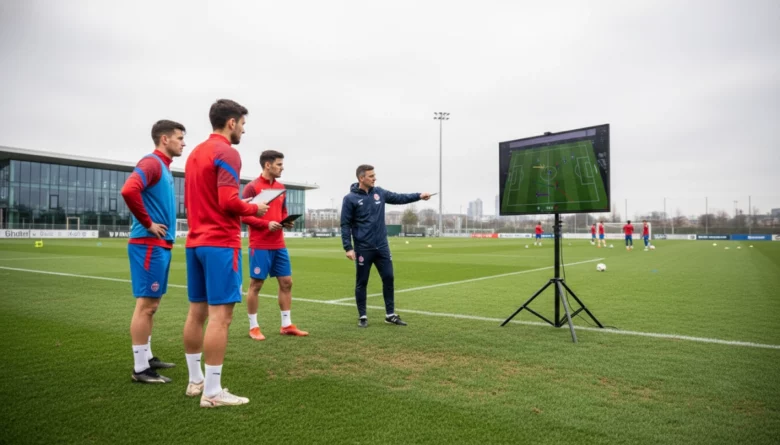
Start each session with a focused video brief — 8–12 minutes that show 3–4 annotated clips illustrating the same positional problem and one successful model instance. Keep voiceover tight: name the one or two cues you want players to use (“step inside to open lane,” “check shoulders before moving”) and finish with a simple challenge they’ll face in the first drill.
Progress the on-pitch work from constrained to game-like so learning transfers:
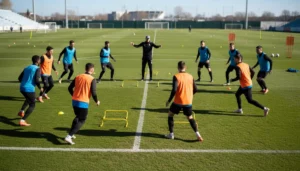
– Warm-up micro-drill (8–10 min): small grids, two-touch passing with fixed receivers and a moving support player. Constraint: receiving player must orient body to a pre-defined angle before the pass can be played. Purpose: rehearse body shape and immediate options.
– Transitional pattern (12–15 min): 4v3/5v4 slices focused on creating/closing lanes. Add a rule that the ball carrier can only play to a supporting player if that player’s torso faces forward by at least 45°. Purpose: emphasize timing and angle.
– Positional rotation/overload (12–18 min): half-pitch, targeted rotations in attacking third with scoring conditions that reward entering specific channels. Purpose: replicate spatial relationships under pressure.
– Small-sided game with focus (15–20 min): SSG where each team has one explicit positional objective (e.g., maintain 7m between lines, or create 3 passing options within 6 seconds). Coach stops play for 20–30s clips to show live video examples when corrections are needed.
Finish with a quick re-run of the opening clip(s) and a player-led reflection: each player states one concrete change they’ll apply next match. This clamps the learning loop and makes feedback actionable.
KPIs to track off-the-ball improvement — what to measure and why
Choose a handful of measurable indicators that directly reflect positioning decisions. Aim for 4–6 KPIs so you can track progress without overwhelming data:
– Passing options created per possession (counts of viable passing lanes within 6 seconds).
– Average distance between lines (m) — measures compactness vs. unnecessary depth.
– Forward-oriented receptions (%) — percent of receptions where the torso faces at least 45° toward opponent goal.
– Time-to-shape after turnover (s) — seconds to regain defensive shape or form a counter-attack shape.
– Successful rotations per attacking sequence — rotations that lead to a progression (shot, final third entry, or completed line break).
– Isolation events per 100 possessions — instances a player is too far from support.
Set baseline values from 2–4 recent matches, then use realistic targets (e.g., +15% forward-oriented receptions, -20% time-to-shape). Use rankings to prioritize: high-impact, low-frequency failures (e.g., late recovery after turnover) should get immediate attention.
Technology workflow: capture, tag, deliver, repeat
Create a simple repeatable pipeline to keep analysis efficient and coachable:
1. Capture: use a wide fixed camera covering half/whole pitch plus a mobile sideline for close-ups. If available, sync GPS/event data.
2. Tagging: within 48 hours, tag sequences by situation (transition, build-up, press) and by KPI (e.g., “bad angle,” “good rotation”). Keep a standardized tag list so clips are searchable.
3. Annotate: add passing lines, distance overlays and slow-motion where timing matters. Limit each clip to 20–40 seconds.
4. Deliver: upload playlists to a player app or LMS with two-line text cues per clip and one drill suggestion. For group sessions, pre-load 8–12 clips into the session playlist.
5. Close the loop: after the session, re-capture training and match footage to measure KPI changes. Repeat the cycle weekly — capture, tag, present, practice, measure — so video moves from diagnostic tool to active learning engine.
Keep the tech simple and coach-friendly: pre-formatted templates, one-click tags, and two prioritized correction points per player keep sessions focused and time-efficient.
Putting the framework into practice
Make adoption manageable: limit the scope, protect time for review, and build a predictable weekly cycle. Keep the player-facing work simple and repeatable so video becomes a rehearsal tool rather than an overload of criticism.
- Cadence: one short video brief + one focused training session per week, with micro-measurements from the following match.
- Clip discipline: present 3–4 annotated clips (20–40s each) that illustrate one coaching cue and one success model.
- Two-point feedback: for each player, choose one corrective cue and one reinforcement cue to use in training and matches.
- Drill fidelity: move from constrained drills to game-like scenarios in every session to secure transfer.
- Measure simply: track 4–6 KPIs consistently and review trends rather than chasing single-play anecdotes.
- Player ownership: end sessions with each player naming one positional change they will try in the next match.
Sustaining positional gains
Changing off-the-ball decisions is an iterative process that rewards consistency. Prioritize clarity over quantity, protect the learning loop (capture, tag, deliver, practice, measure), and trust small, frequent adjustments—those compound into reliable team shape. If you want additional practical drills and coaching templates, consult FIFA’s coaching resources for session ideas and applied examples.